

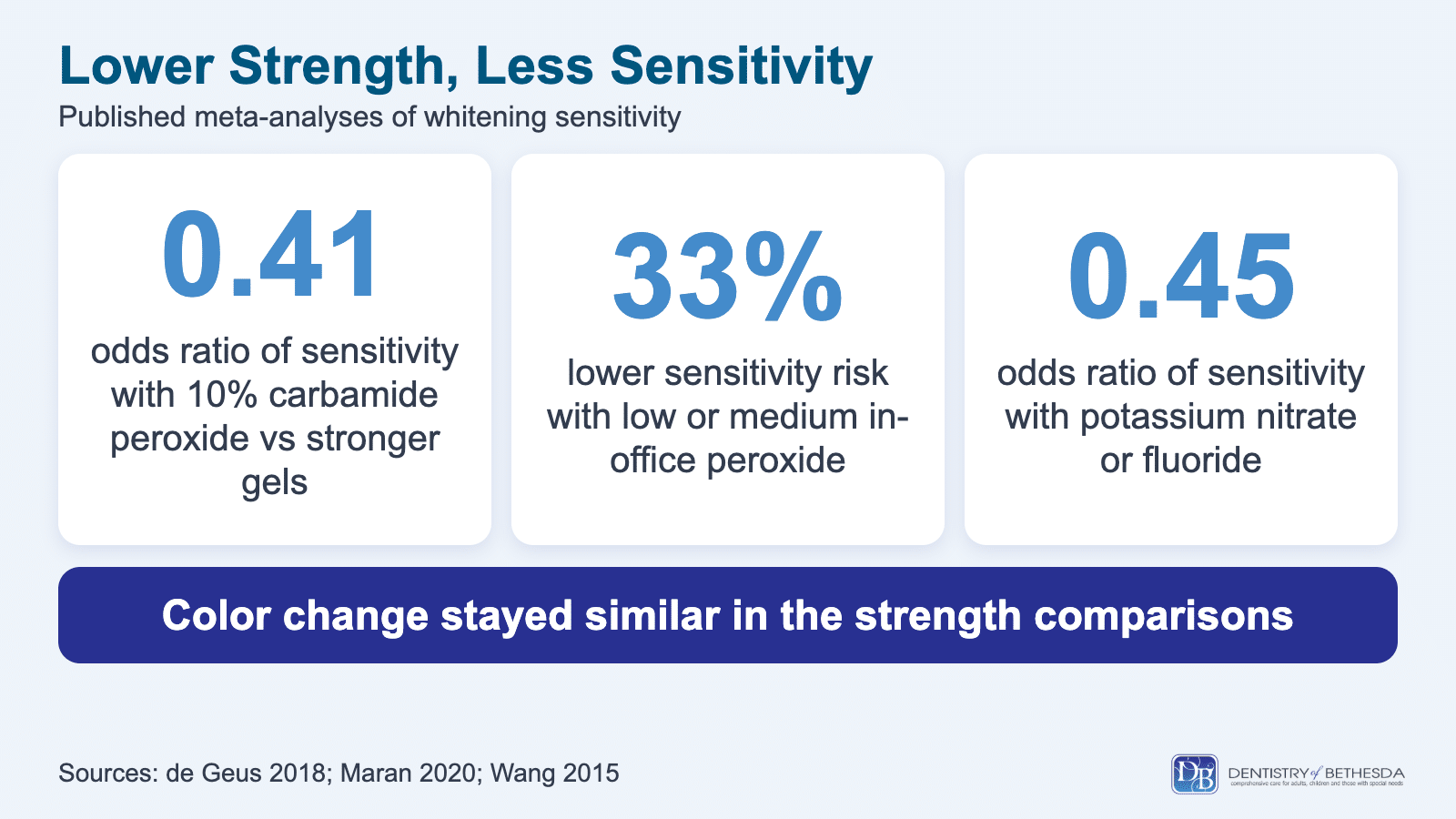
Teeth whitening for sensitive teeth is possible with a lower peroxide strength, a dental exam first, and a slower schedule. A 2018 Cochrane review of 71 trials and 3,780 adults named sensitivity the most common side effect, mild and temporary. A 2018 meta-analysis found 10% carbamide peroxide gels carried an odds ratio of 0.41 for sensitivity against stronger gels.
Key Takeaways
- Cochrane found that sensitivity and irritation are the most common whitening side effects and rise with higher concentrations.
- Lower-strength gels lightened teeth as well as stronger gels in two meta-analyses while causing less sensitivity.
- Potassium nitrate and sodium fluoride desensitizers lowered sensitivity during bleaching, with an odds ratio of 0.45.
- The ADA says whitening sensitivity is temporary in most cases, and treatment can be delayed and retried.
- Sensitivity that lingers may come from cavities, worn enamel, or gum recession, which need a dentist before more bleaching.
Can You Do Teeth Whitening for Sensitive Teeth?
Teeth whitening for sensitive teeth can be done once a dentist checks the sensitivity and the plan uses lower peroxide strength. A dentist exam comes before any bleaching gel. The ADA lists cavities, fractured teeth, worn fillings, gum disease, and worn enamel as causes of sensitive teeth.
Each cause needs its own treatment, and bleaching does not repair any of them. Our gentle whitening plans begin with that exam, so the whitening step starts on teeth that are ready for it.
Why Do My Teeth Hurt Sharply During Whitening?
Teeth hurt sharply during whitening because peroxide gets through enamel to the dentin and irritates the nerve. Peroxide reaches the nerve through dentin, according to the ADA. Dentin contains microscopic tubules, and these tubules let heat, cold, and acidic foods reach the nerve.
The brief electric jolts that people call zingers follow that same path. Gums that have receded expose more dentin, so recession raises the odds of sharp pain.
What Is the Most Effective Teeth Whitening for Sensitive Teeth?
The most effective teeth whitening for sensitive teeth uses a lower peroxide strength, which lightened teeth about as well with less sensitivity. Lower strength gave the same color change in two meta-analyses. One covered 10% carbamide peroxide trays, and the other covered low and medium in-office hydrogen peroxide.
Researchers have compared strengths, desensitizers, and light activation directly. The table below lists each comparison and what the data showed.
Strength is the one setting that lowers sensitivity without lowering results, and light adds nothing. The next question is whether any option avoids sensitivity entirely.
Is There a Teeth Whitening That Doesn’t Cause Sensitivity?
No teeth whitening treatment is free of sensitivity, so a non sensitive teeth whitening product does not exist in the research. Cochrane reported sensitivity as the most common side effect of home bleaching. The risk rises with concentration, and lower strengths reduce it.
Whitening toothpastes sit at the gentle end, since a 2014 clinical review noted that they lighten about 1 or 2 shades.
Is Professional Teeth Whitening for Sensitive Teeth Better?
Professional teeth whitening for sensitive teeth is not better or worse by default. A pooled comparison found no difference. de Geus and colleagues pooled 8 trials in 2016. They found no difference in sensitivity or whitening between at-home and in-office bleaching.
The protocol matters more than the setting. A dentist controls strength, contact time, and gum protection. The ADA notes that in-office bleaching covers the gums with a gel or rubber shield.
How Do You Prepare Sensitive Teeth for Whitening?
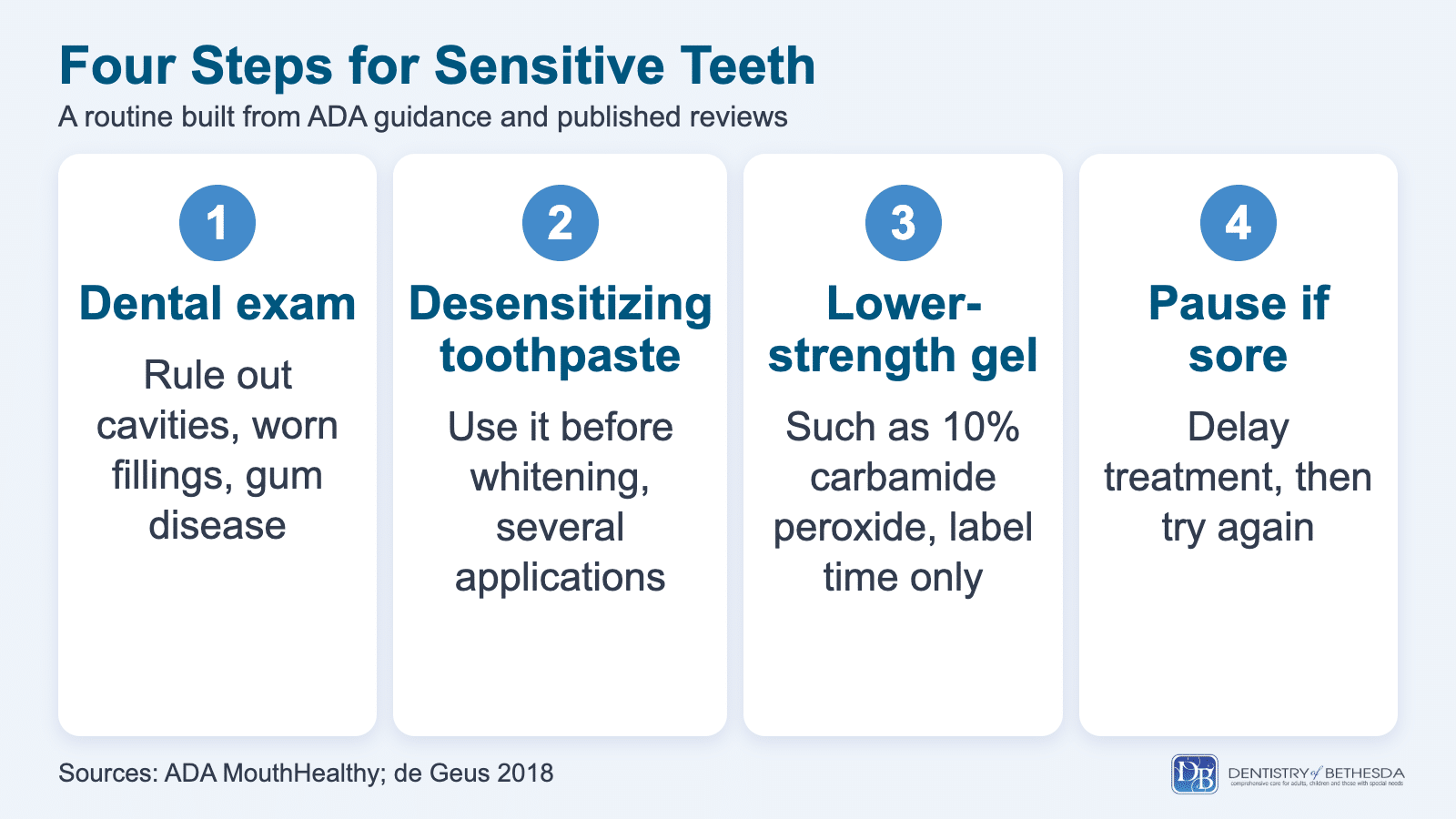
Preparing sensitive teeth for whitening starts with a dental exam and a desensitizing toothpaste, then a lower-strength gel. Four steps prepare sensitive teeth. Each step maps to evidence from the ADA or from the reviews above.
- Book a dental exam to rule out cavities, worn fillings, and gum disease.
- Brush with a desensitizing toothpaste, which the ADA says usually needs several applications to work.
- Choose a lower-strength gel, such as 10% carbamide peroxide, and follow the label time.
- Pause the treatment for a few days if teeth feel sore, then resume.
The ADA states that desensitizing toothpaste contains compounds that block transmission of sensation from the tooth surface to the nerve. Treating sensitivity signals before bleaching keeps the routine comfortable.
Do Desensitizing Toothpastes Work Before Whitening?
Desensitizing toothpastes work before whitening in some protocols and not in others. A 2024 systematic review of 5 studies and 387 people found they reduced sensitivity after 22% carbamide peroxide home bleaching. They also helped after single-session 35% hydrogen peroxide bleaching. They did not help after 16% carbamide peroxide or two-session in-office bleaching.
A 2006 Cochrane review of potassium toothpastes for everyday dentine hypersensitivity found no clear evidence of benefit because the studies were small. That result applies to everyday sensitivity, not bleaching specifically. A dentist can match the product to the protocol.
What Does Teeth Whitening for Sensitive Teeth Involve?
Teeth whitening for sensitive teeth involves an exam, gum protection, a lower-strength gel, and a pause plan. Whitening treatments for sensitive teeth follow the same three formats as regular whitening. The formats are chairside bleaching, dentist-made trays, and store-bought products.
The ADA says chairside bleaching usually takes one office visit, with a gel or rubber shield covering the gums. Dentist-made trays let the dentist set the gel strength and wear time. Our supervised whitening care uses those controls.
How Do Whitening Treatments for Sensitive Teeth Compare?
Whitening treatments for sensitive teeth compare by strength, wear time, and who controls both. A 2014 clinical review tested strips at 6.5% hydrogen peroxide, gels at 10% and 22% carbamide peroxide, and in-office 35% hydrogen peroxide. Strips lightened 1 or 2 shades after 14 days of twice-daily use.
- Strips apply a fixed strength for 30 minutes twice daily over 14 days.
- Dentist-made trays hold carbamide peroxide gel for 2 to 4 hours a day or overnight.
- In-office bleaching applies higher strengths in one 30- to 60-minute treatment.
The ADA adds that store-bought concentrations are lower than what a dentist uses in the office. Our home kit options page covers the take-home choices.
Does Light Make In-Office Whitening Gentler?
Light does not make in-office whitening gentler, because 21 randomized trials showed no change in sensitivity. Maran and colleagues reported in 2018 that light activation did not improve color change either. Gel strength and contact time decide the outcome.
A 2014 review also noted that the ADA does not endorse light activation. That leaves strength as the lever worth adjusting.
What to Do If Teeth Whitening Makes Teeth Sensitive?
When teeth whitening makes teeth sensitive, pause the treatment, switch to desensitizing toothpaste, and avoid hot, cold, acidic, or sticky foods. Pausing treatment is the first move, since the ADA advises delaying whitening and trying again. Sensitivity is temporary in most cases.
The ADA explains that exposed dentin lets heat, cold, acidic, and sticky foods reach the nerve. Removing those triggers lowers the signal while the tooth settles.
- Pause bleaching and keep the gel off the teeth until the soreness fades.
- Brush gently with a desensitizing toothpaste twice a day.
- Choose room-temperature drinks and soft, non-acidic foods.
- Resume at a lower strength or shorter wear time once comfortable.
Review post-whitening habits to keep the routine going after the sensitivity passes.
How to Make Sensitive Teeth Stop Hurting After Whitening?
To make sensitive teeth stop hurting after whitening, pause bleaching and use desensitizing toothpaste with gentle brushing. The ADA says this type of toothpaste blocks sensation from the surface to the nerve. Several applications are usually needed before sensitivity drops.
A 2015 meta-analysis found that potassium nitrate and sodium fluoride cut the odds of sensitivity during bleaching to 0.45. A 2021 meta-analysis of potassium nitrate before bleaching found a 12% lower risk and called the benefit subtle.
How Do You Stop Sensitive Teeth Pain Fast?
To stop sensitive teeth pain fast, remove the trigger and use an over-the-counter pain reliever as the label directs. No treatment acts instantly, but the ADA lists ibuprofen and acetaminophen for acute dental pain. Sensitivity usually settles with time.
A dentist can apply a professional desensitizing treatment if the pain continues. The next section covers medicine choices.
What to Avoid Immediately After Teeth Whitening?
Immediately after teeth whitening, avoid very hot, very cold, acidic, and sticky foods and drinks. These items travel through exposed dentin tubules to the nerve, according to the ADA. Sparing the tooth those triggers lowers the chance of zingers.
Gentle brushing and room-temperature water make an easy default while the teeth settle.
How Long Will Tooth Pain Last After Whitening?
Tooth pain after whitening lasts several days in the clinical record. A 2014 clinical review reported that sensitivity usually occurs during treatment and can last several days. Gum irritation begins within a day and can also last several days.
Zingers follow the same timeline, and they fade as the gel stops reaching the nerve. Pain that stays beyond several days calls for a dental exam.
Is Tooth Sensitivity After Whitening Permanent?
Tooth sensitivity after whitening is not permanent in the research record. Cochrane described the effect as mild and transient, and the ADA says sensitivity is temporary in most cases. Cochrane also noted that the evidence was low to very low certainty over short periods.
Sensitive teeth after whitening that do not recover may point to an unrelated cause such as decay or recession. A dentist can find it with an exam.
Is Nerve Pain Normal After Teeth Whitening?
Nerve irritation is a known effect of whitening, because peroxide reaches the nerve through dentin. The ADA describes this as sensitivity that is temporary in most cases. Brief, sharp sensitivity matches the pattern, while pain that lingers does not.
Throbbing, swelling, or pain beyond several days needs a prompt dental exam, since cavities, cracks, and worn fillings also cause nerve pain.
What Pain Reliever Can You Take After Teeth Whitening?
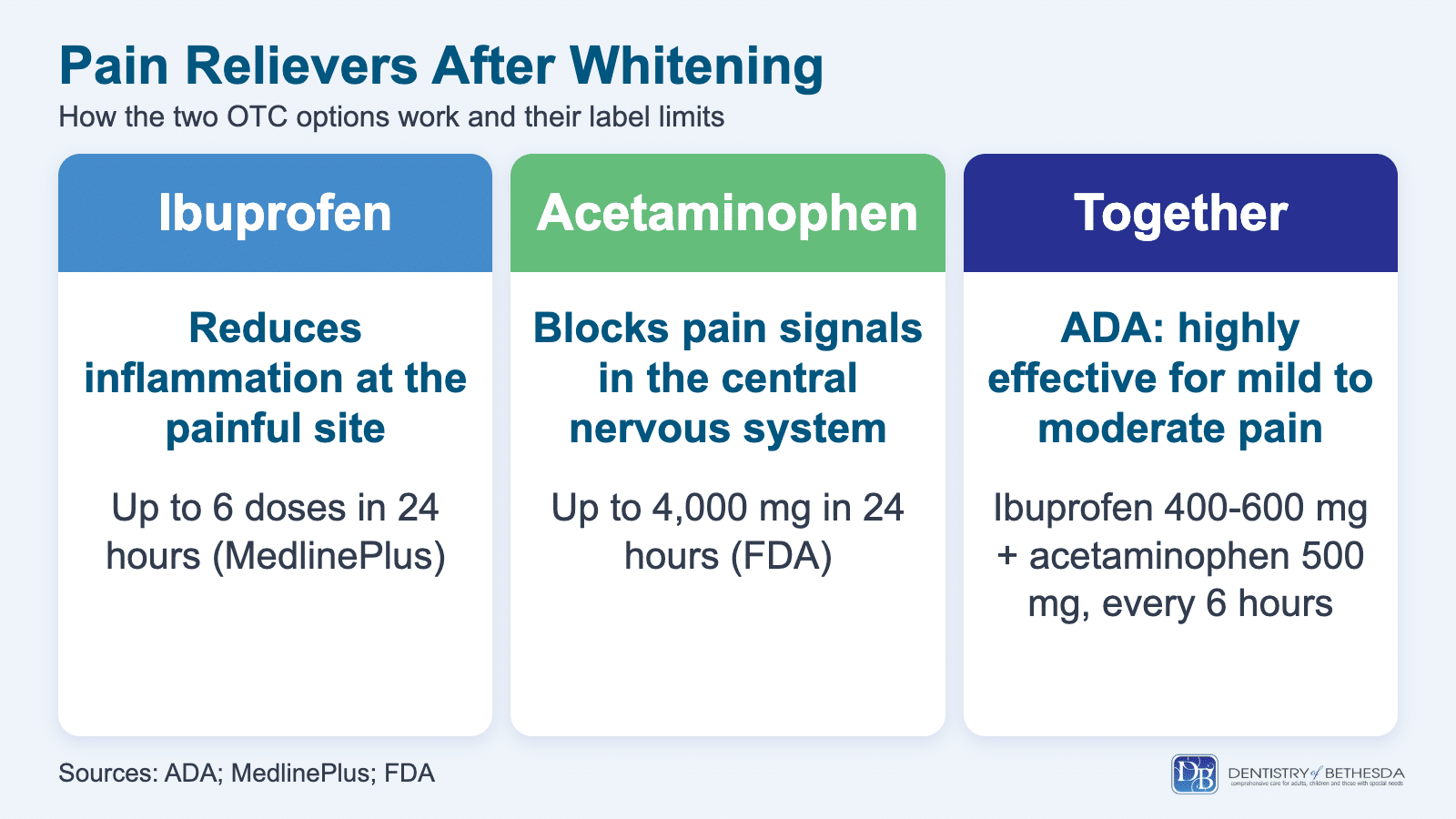
Over-the-counter ibuprofen or acetaminophen can be taken after teeth whitening, following the label limits. Ibuprofen targets inflammation and acetaminophen acts on pain signals centrally, according to the ADA. The right choice depends on health history, so a dentist or pharmacist should confirm it.
MedlinePlus states that adults may take nonprescription ibuprofen every 4 to 6 hours and no more than 6 doses in 24 hours. The FDA sets the acetaminophen maximum for adults at 4,000 mg in 24 hours.
Which Is Better for Tooth Pain, Acetaminophen or Ibuprofen?
Neither acetaminophen nor ibuprofen is better for every person, since the ADA says no single regimen works for everyone. Ibuprofen reduces inflammation at the painful site. Acetaminophen blocks pain signaling in the central nervous system.
MedlinePlus warns that NSAIDs such as ibuprofen may cause stomach ulcers and bleeding. People with liver or kidney disease should ask a doctor before using either drug.
Does Tylenol Help With Tooth Sensitivity After Whitening?
Tylenol, which is acetaminophen, can help with dental pain, but no trial has tested it for whitening sensitivity. The ADA lists acetaminophen as an analgesic for acute dental pain. Acetaminophen acts centrally rather than on inflammation.
Sensitivity from exposed dentin is best managed by removing triggers and using desensitizing toothpaste. Acetaminophen is a supporting option for comfort.
Can You Take Ibuprofen and Tylenol Together for Tooth Pain?
Ibuprofen and Tylenol can be taken together for tooth pain. The ADA calls the combination highly effective for mild to moderate pain. The ADA lists ibuprofen 400 to 600 mg plus acetaminophen 500 mg every 6 hours for adults after dental procedures. Many people call this pairing the ibuprofen and Tylenol cocktail.
Three ibuprofen tablets with two Tylenol tablets, or 800 mg of ibuprofen with 500 mg of acetaminophen, exceed the ADA example doses. Total acetaminophen above 4,000 mg a day has been linked to acute liver failure. A pharmacist can confirm the amounts for each person.
What Else Should You Know About Teeth Whitening for Sensitive Teeth?
Should You Stop Teeth Whitening If You Get Zingers?
Stopping teeth whitening when zingers start is the ADA-aligned move, since the ADA says to delay treatment and try again. Zingers signal that peroxide is reaching the nerve, so delay treatment and try again. A lower strength or shorter wear time usually follows.
How to Get Rid of Super Sensitive Teeth?
To get rid of super sensitive teeth, a dentist first finds the cause, because the right treatment depends on it. The ADA lists desensitizing toothpaste, a crown, inlay, or bonding, a gum graft, and a root canal. Each fits a different cause, from decay to lost gum tissue to severe, persistent pain. Our gum recession page explains the gum-related cause.
Can Yellow Teeth Actually Be Whitened?
Yellow teeth can be whitened, and the ADA says yellow teeth bleach well. Brown teeth may respond less, and gray teeth may not bleach at all. Whitening does not change crowns, veneers, or fillings.
Why Did My Teeth Go Back to Yellow After Whitening?
Teeth go back to yellow after whitening when coffee, tea, and red wine add stain. Thin enamel also shows yellow dentin, and the ADA names both causes. A lab color-stability study cited in a 2014 review found yellowness did not return to baseline within 1 year.
Is Toothpaste Enough for Sensitive Teeth Whitening?
Toothpaste is enough for mild stain, since whitening toothpaste lightens about 1 or 2 shades in a 2014 clinical review. The ADA says Seal toothpastes polish away surface stain with mild abrasives. Toothpaste suits mild stains. Deeper stain needs peroxide at a strength a dentist selects.
Frequently Asked Questions
Is There a Downside to Teeth Whitening?
The main downside of teeth whitening is temporary tooth sensitivity and gum irritation, according to Cochrane. The ADA adds that overuse can damage enamel or gums, so follow label directions and ask a dentist.
Can Whitening Make Gums Sore?
Whitening can make gums sore, because gingival irritation begins within a day and can last several days. A 2014 clinical review reported that timeline. A gum shield or well-fitted tray keeps gel off the gums.
Why Is Teeth Whitening for Sensitive Teeth and Gums Handled Differently?
Teeth whitening for sensitive teeth and gums is handled differently because gums need protection from the gel. In-office bleaching uses a gum gel or rubber shield, according to the ADA. Gums that have receded also expose root dentin.
How Does Dentistry of Bethesda Help With Teeth Whitening for Sensitive Teeth?
Dentistry of Bethesda helps with tooth whitening for sensitive teeth by checking the cause of sensitivity first, then selecting a lower-strength plan. Dr. Hornstein reviews the teeth and gums at our Bethesda office. We look for the cavity signs that can be mistaken for whitening sensitivity.
Patients can review the whitening timeline to see how results build across visits. The ADA adds that yellow teeth bleach well while gray teeth may not respond, and Dr. Hornstein explains which group a patient falls into.
Sensitivity questions are welcome at every visit with our dentists. Follow-up visits check how the teeth feel after treatment. They also show whether the strength, wear time, or schedule needs to change.
A short visit covers the exam, the strength choice, the wear time, and the pause plan before any gel touches the teeth. Dr. Hornstein reviews each of these choices with the patient. Patients who want a plan can book a consultation and ask about whitening options for sensitive teeth.