

Yes, hydrogen peroxide teeth whitening is safe when a formulated product is used as directed. A Cochrane review of 71 trials found sensitivity and gum irritation mild and temporary. Strips at 6.5% hydrogen peroxide were among the products tested. Peroxide lightens natural enamel only, and bottled 3% household peroxide is not a tested whitening product.
Key Takeaways
- Hydrogen peroxide and carbamide peroxide are the two bleaches in whitening products, according to the American Dental Association (ADA).
- Cochrane reviewed 71 trials with 3,780 adults and found sensitivity and irritation mild and temporary.
- Strips at 6.5% hydrogen peroxide and trays with carbamide peroxide gel lighten teeth by 1 or 2 shades.
- Crowns, veneers, and fillings do not whiten, and brown or gray teeth may respond less.
- No clinical trial in the sources reviewed tests bottled 3% peroxide or baking soda paste as a whitener.
How Does Hydrogen Peroxide Teeth Whitening Work?
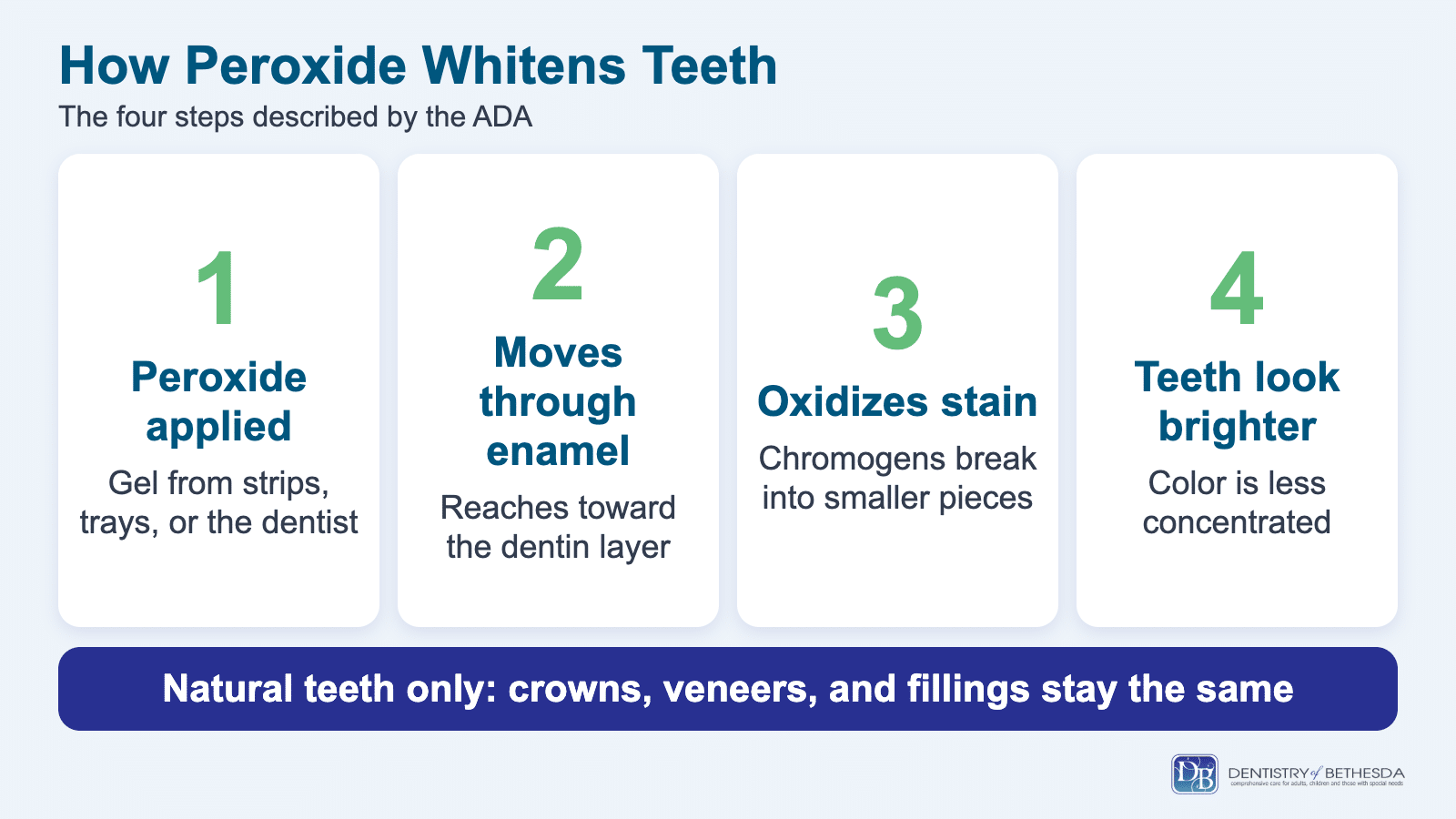
Hydrogen peroxide teeth whitening works by oxidation, which breaks stain compounds into smaller, lighter pieces. Smaller pieces make the color less concentrated, according to the ADA. The peroxide moves through enamel toward the dentin, which explains why sensitivity can follow.
Dentists apply this chemistry through a supervised whitening treatment, and store products use the same bleaches. The ADA states that over-the-counter bleaching products contain less peroxide than a dentist uses in the office.
Carbamide peroxide is the second bleach. According to Carey in the Journal of Evidence-Based Dental Practice, carbamide peroxide breaks down in contact with water to release hydrogen peroxide. Carbamide peroxide teeth whitening therefore ends in the same chemistry.
The graphic below shows the four steps the ADA describes.
What Does Peroxide Do to Yellow Teeth?
Peroxide lightens yellow teeth by oxidizing the colored compounds, called chromogens, that sit in and on the tooth. Coffee, tea, and red wine are major chromogen sources, according to the ADA. The ADA also notes that thinning enamel lets yellowish dentin show through.
Peroxide for teeth whitening therefore acts on stain, not on enamel thickness. That limit leads to the next question about how far the bleaching can go.
Can Hydrogen Peroxide Fix Yellow Teeth?
Hydrogen peroxide can lighten yellow teeth, and the ADA says yellow teeth will probably bleach well. Brown teeth may not respond as well, and teeth with gray tones may not bleach at all, per the ADA.
Peroxide does not change veneers, crowns, or fillings, according to the ADA. Carey reports a typical gain of 1 or 2 shades from home products. Safety is the next concern for most patients.
Is It Safe to Use Hydrogen Peroxide to Whiten Your Teeth?
Yes, it is safe to use hydrogen peroxide to whiten your teeth when a formulated product is used as directed. Following manufacturer instructions is the condition, according to Carey’s 2014 review of hydrogen peroxide and carbamide peroxide whitening.
The Cochrane review of 71 trials and 3,780 adults named sensitivity and oral irritation as the most common side effects. Cochrane described them as mild and transient, and more common at higher concentrations. Cochrane rated the evidence low to very low certainty over 2 weeks to 6 months.
The ADA states that sensitivity is usually temporary and that overuse can damage enamel or gums. Patients can read about sensitivity warning signs that call for an exam. Household peroxide strength is the next safety question.
Is 3% Hydrogen Peroxide Safe for Your Teeth?
Whether 3% hydrogen peroxide is safe for your teeth is not settled by clinical trials. The Cochrane trials tested formulated gels, strips, and mouthwashes, not bottled household antiseptic.
Carey reports that hydrogen peroxide lowers the pH on the tooth surface during treatment. Laboratory studies linked that drop to surface demineralization. The ADA adds that overuse of whiteners can damage enamel or gums. Strength is the follow-up question.
Is 3% Hydrogen Peroxide Strong Enough to Whiten Teeth?
Three percent hydrogen peroxide has no clinical trial evidence as a stand-alone whitener in the sources reviewed. Whitening strength is unproven at 3%, while tested products used higher or longer-contact formats.
Carey lists the products studied as strips at 6.5% hydrogen peroxide, gels at 10% and 22% carbamide peroxide, and 35% hydrogen peroxide. Strips hold gel against the tooth for 30 minutes per session. The table below compares these formats.
How Do Hydrogen Peroxide Teeth Whitening Options Compare?
Hydrogen peroxide teeth whitening options compare by peroxide concentration, wear time, and who applies the gel. In-office treatment is the shortest, with one visit of 30 to 60 minutes, according to Carey.
The table shows that teeth whitening hydrogen peroxide products trade speed for strength. Carey also found 10% carbamide tray whitening similar to 35% hydrogen peroxide in a 90-patient split-mouth trial. Patients weighing home whitening kits can use these formats as a guide.
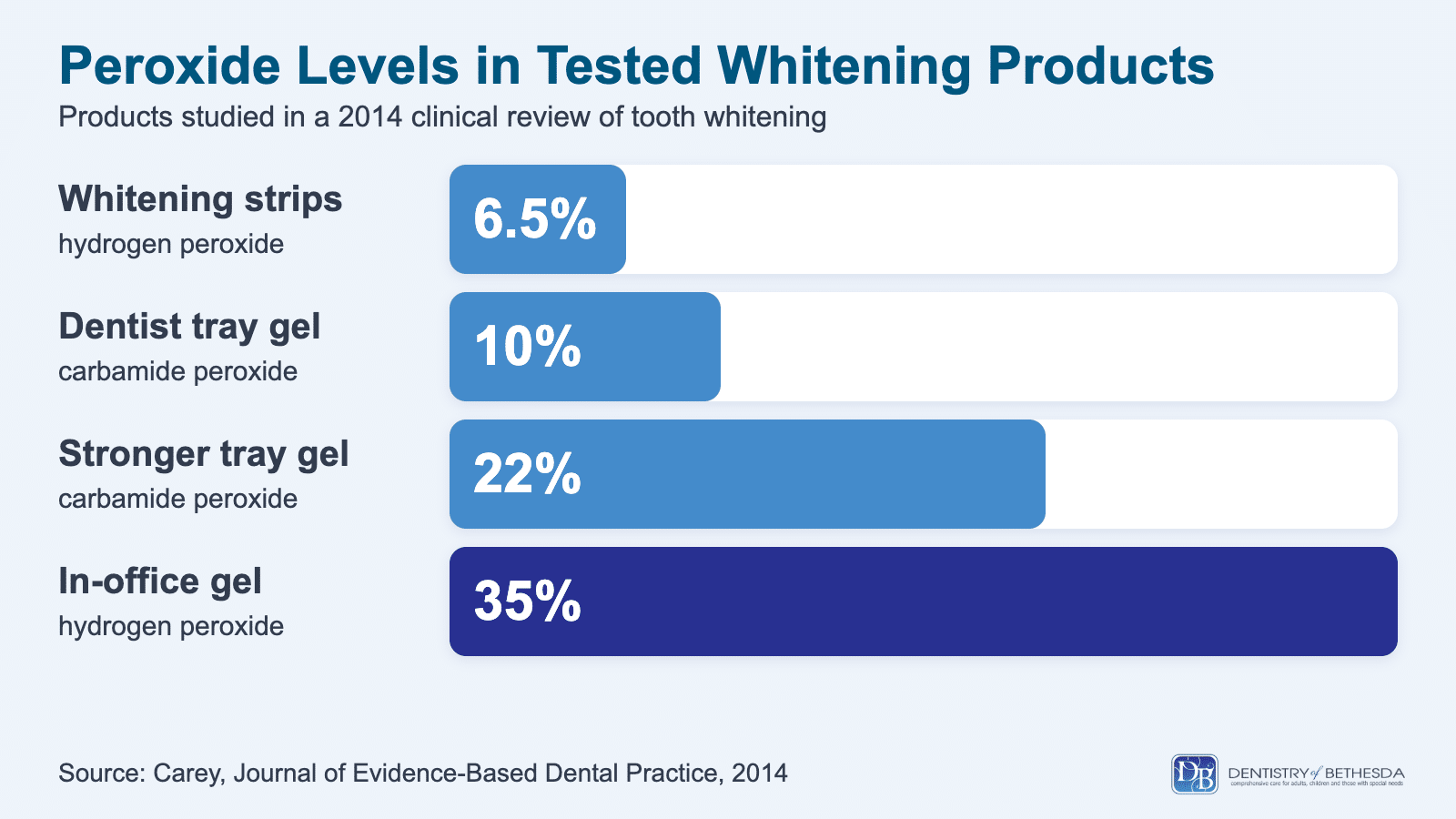
The chart above shows the concentrations from Carey’s review side by side. Application steps come next.
How Do I Use Hydrogen Peroxide to Whiten My Teeth?
Use hydrogen peroxide to whiten your teeth by following the written directions on a formulated strip, tray gel, or dentist-supplied product. The ADA seal marks bleaching products found safe and effective on natural teeth.
- Choose a formulated strip or tray gel, not a bottled household antiseptic.
- Read the label for the wear time and the number of days.
- Place the gel on the teeth only, and keep it off the gums.
- Remove the strip or tray when the timer ends, then rinse.
- Pause if sensitivity builds, since the ADA says patients can delay treatment and try again.
The ADA notes that a dentist can supply a custom-made tray with timing instructions. A dentist-guided whitening plan fits teeth that already have dental work. Timing is the next detail.
How Long Does It Take for Hydrogen Peroxide to Whiten Your Teeth?
Hydrogen peroxide takes several days to 2 weeks to whiten teeth at home and one 30- to 60-minute visit in the office. Strips show lightening in several days on the 14-day routine, according to Carey.
Trays with carbamide peroxide give noticeable whitening in a few days, per Carey. The Cochrane trials followed patients for 2 weeks to 6 months. Fading is gradual, as shown in how bleaching works over time.
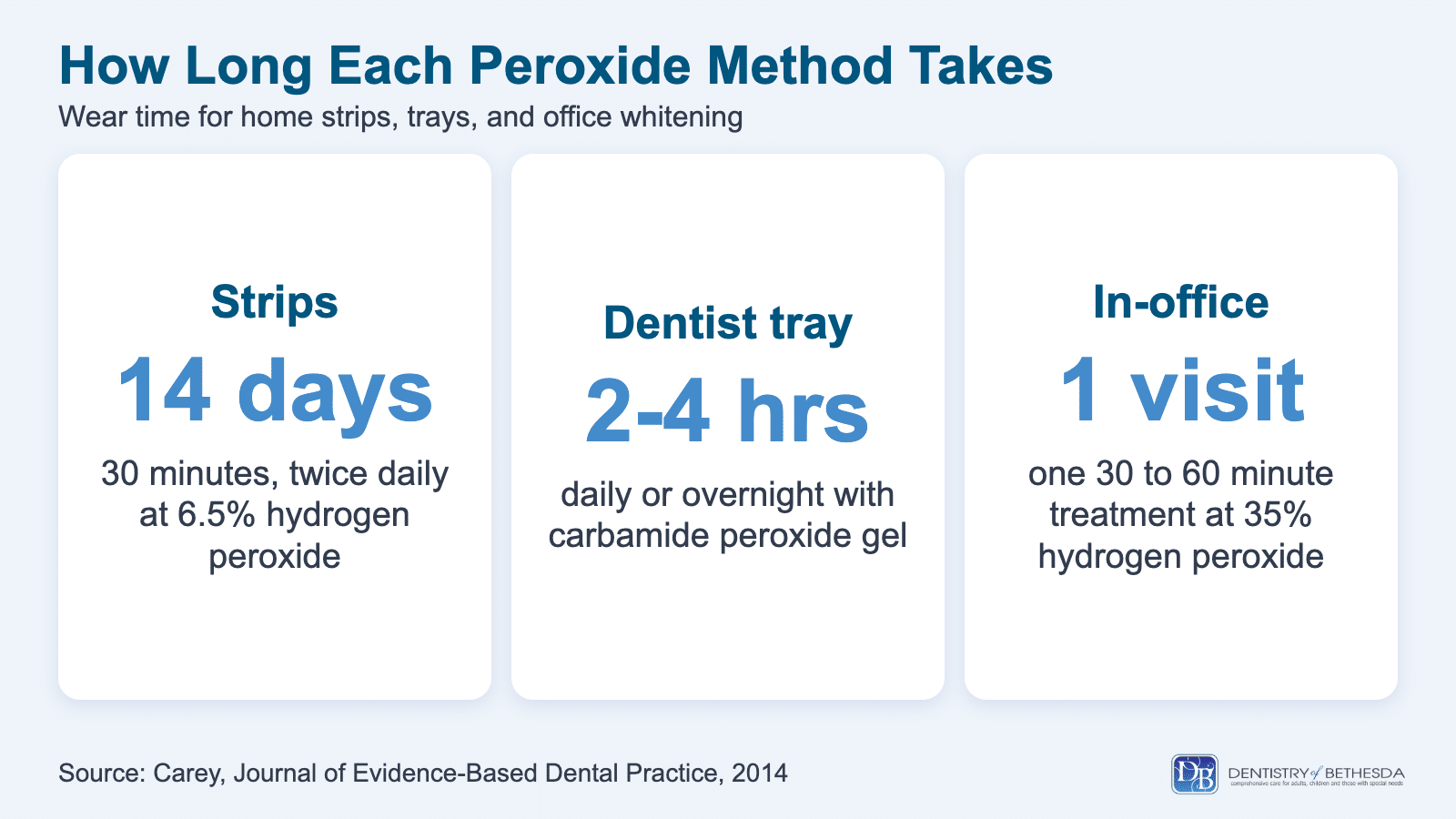
The timeline graphic summarizes the three schedules. Contact time is the related question.
How Long Do I Let Hydrogen Peroxide Sit on My Teeth?
Let hydrogen peroxide sit on your teeth for the wear time printed on the product. A standard strip stays on for 30 minutes, according to Carey, and newer strips use one 30-minute session daily.
Tray gels are worn 2 to 4 hours a day or overnight, per Carey. No source reviewed sets a contact time for bottled 3% peroxide. Frequency is the next limit to understand.
How Often Can I Use 3% Hydrogen Peroxide on My Teeth?
No source sets a safe frequency for using 3% hydrogen peroxide on your teeth. The safe schedule is the one printed on a formulated product, such as twice daily for 14 days with strips.
The ADA warns that overuse of whiteners can damage enamel or gums. Cochrane trials ran 2 weeks to 6 months, so daily use beyond a label schedule is untested. Speed is the next topic.
What Whitens Teeth Really Fast?
In-office whitening whitens teeth fastest, with results after one 30- to 60-minute treatment. Higher peroxide concentrations drive the speed, according to Carey, and the dentist protects the gum tissue first.
Light activation adds no benefit, and the ADA does not endorse light-activated systems, per Carey. Home bleaching causes less sensitivity than in-office bleaching when instructions are followed. A whitening cost conversation helps match speed to goals. Homemade mixes are the next common question.
What About Baking Soda and Peroxide for Teeth Whitening?
Baking soda and peroxide for teeth whitening is a homemade paste with no trial evidence in the Cochrane review. That review tested gels, strips, paint-on gels, chewing gum, and mouthwash, not a baking soda paste.
Carey notes that whitening toothpastes contain higher abrasives and detergents to remove stain. A review in the Journal of the American Dental Association reported enamel abrasion in some studies of homemade charcoal powders. Brushing is the first mix question.
Is It Okay to Brush Your Teeth With Baking Soda and Hydrogen Peroxide?
Brushing your teeth with baking soda and hydrogen peroxide is not supported by clinical trials. The ADA says overuse of whiteners can damage enamel or gums, so labeled products are the safer route.
An ADA-accepted whitening toothpaste already carries polishing agents that the ADA calls safe for teeth. Timing is the next question.
How Long Does It Take to Whiten Teeth With Baking Soda and Peroxide?
No clinical trial reports how long baking soda and peroxide take to whiten teeth. Formulated strips show lightening in several days, according to Carey, and that is the tested benchmark.
Without trial data, a homemade timeline stays a guess. The grouped questions below cover related mixes and side effects.
What Else Should You Know About Hydrogen Peroxide Whitening?
Can I Mix Hydrogen Peroxide With My Toothpaste?
Mixing hydrogen peroxide into toothpaste is not a tested whitening method. Whitening toothpastes with the ADA Seal already include polishing agents for surface stain, according to the ADA.
Do Dentists Recommend Rinsing With Hydrogen Peroxide?
Rinsing with hydrogen peroxide is tested only as a formulated whitening mouthwash. Cochrane listed hydrogen peroxide mouthwash among the tested agents, with low to very low certainty, and did not test bottled antiseptic.
What Should You Do If Peroxide Burned Gums From Teeth Whitening?
Peroxide burned gums from teeth whitening show up as irritation that begins within a day. The irritation can last several days, according to Carey.
Stop the product, rinse with water, and call the dentist if soreness lasts beyond several days. Gum soreness can also signal gum care needs.
How Can I Whiten My Teeth at Home Without Hydrogen Peroxide?
Peroxide free teeth whitening relies on abrasives that scrub surface stain, which the ADA says all toothpastes do. Whitening toothpaste lightens teeth by about 1 or 2 shades, according to Carey.
A 2018 systematic review of 9 randomized trials found whitening dentifrices changed tooth color more than non-whitening ones. Non peroxide teeth whitening does not reach deeper stains. The JADA charcoal review found insufficient data to support safety claims for charcoal pastes. No source reviewed supports a 2-minute method. Deeper discoloration usually needs a dental exam.
Who Should Skip Hydrogen Peroxide Whitening Without a Dental Exam First?
Patients with certain conditions should skip hydrogen peroxide whitening until a dentist has examined them. The list below shows who this covers.
- Teeth with restorations, since Carey reports more sensitivity and pain in restored teeth.
- Cavities, gum disease, worn enamel, or exposed roots, per the Opalescence manufacturer FAQ.
- Pregnancy and breastfeeding, since the same FAQ states no whitening safety studies exist.
- Children under 12, per the same manufacturer FAQ.
A cleaning and exam checks these conditions before bleaching starts.
Frequently Asked Questions
How Long Does 3% Hydrogen Peroxide Take to Whiten Teeth?
No trial reports a time for 3% hydrogen peroxide. Formulated strips show lightening in several days and about 1 or 2 shades after 14 days, according to Carey.
Is It Safe to Mix Hydrogen Peroxide and Baking Soda?
No clinical trial tests the mix, and the ADA says overuse of whiteners can damage enamel or gums. A labeled strip or tray follows tested directions instead.
How Do I Make My Teeth Whiter Instantly?
No home method whitens teeth instantly. In-office treatment is the fastest, with results after one 30- to 60-minute visit, according to Carey.
How Does Dentistry of Bethesda Help With Hydrogen Peroxide Teeth Whitening?
We help with hydrogen peroxide teeth whitening by matching the peroxide option to your teeth, existing dental work, and sensitivity. Dr. Hornstein examines your mouth first, then recommends in-office or take-home whitening.
Our Bethesda office checks for cavities, gum problems, and restorations before any bleaching. A whitening consultation covers the shade goals and the schedule. Take-home trays follow the same label-based timing described above.
After whitening, patients can follow our after-whitening care steps for the first days. Staining foods and drinks, such as coffee, tea, and red wine, are the main chromogen sources named by the ADA. Those same compounds are what peroxide breaks down.
Patients with questions about peroxide products can ask Hornstein’s dental team at any visit.