

No, a root canal causes little to no pain during treatment because the dentist numbs the tooth, according to the ADA. Pain before treatment comes from the infected pulp. A review of 72 studies found pain in 81% of patients before treatment. Pain fell to 40% at 24 hours and 11% at 1 week. The NHS says appointments last 1 to 2 hours, and soreness settles within a couple of weeks.
Key Takeaways
- The answer to “does a root canal hurt” is no, with little to no pain under local anesthesia, according to the ADA.
- The answer to “how painful is a root canal” is mild, at 24 out of 100 severity after 24 hours.
- Pain prevalence fell from 81% before treatment to 40% at 24 hours and 11% at 1 week in a 72-study review.
- A root canal takes 1 or 2 office visits of 1 to 2 hours or longer, per the ADA and NHS.
- Teeth without a crown after treatment were lost at 6.0 times the rate of crowned teeth in a University of Iowa study.
- Throbbing pain, swelling, or pain that lasts past a couple of weeks should prompt a call to the dentist.
Does a Root Canal Hurt?
A root canal does not hurt much, because the ADA reports little to no pain when the dentist uses local anesthesia. Local anesthesia blocks the nerves that sense pain in one area of the mouth. The pain comes before treatment, when the infected pulp inflames the tooth.
The pulp is the soft tissue inside a tooth that holds nerves and blood vessels. According to the ADA, patients should no longer feel the old pain once the procedure ends. We provide root canal care for infected teeth. The ADA lists a deep cavity, repeated dental work, a crack, and injury as causes of pulp infection.
How Much Does a Root Canal Hurt on a Scale of 1 to 10?
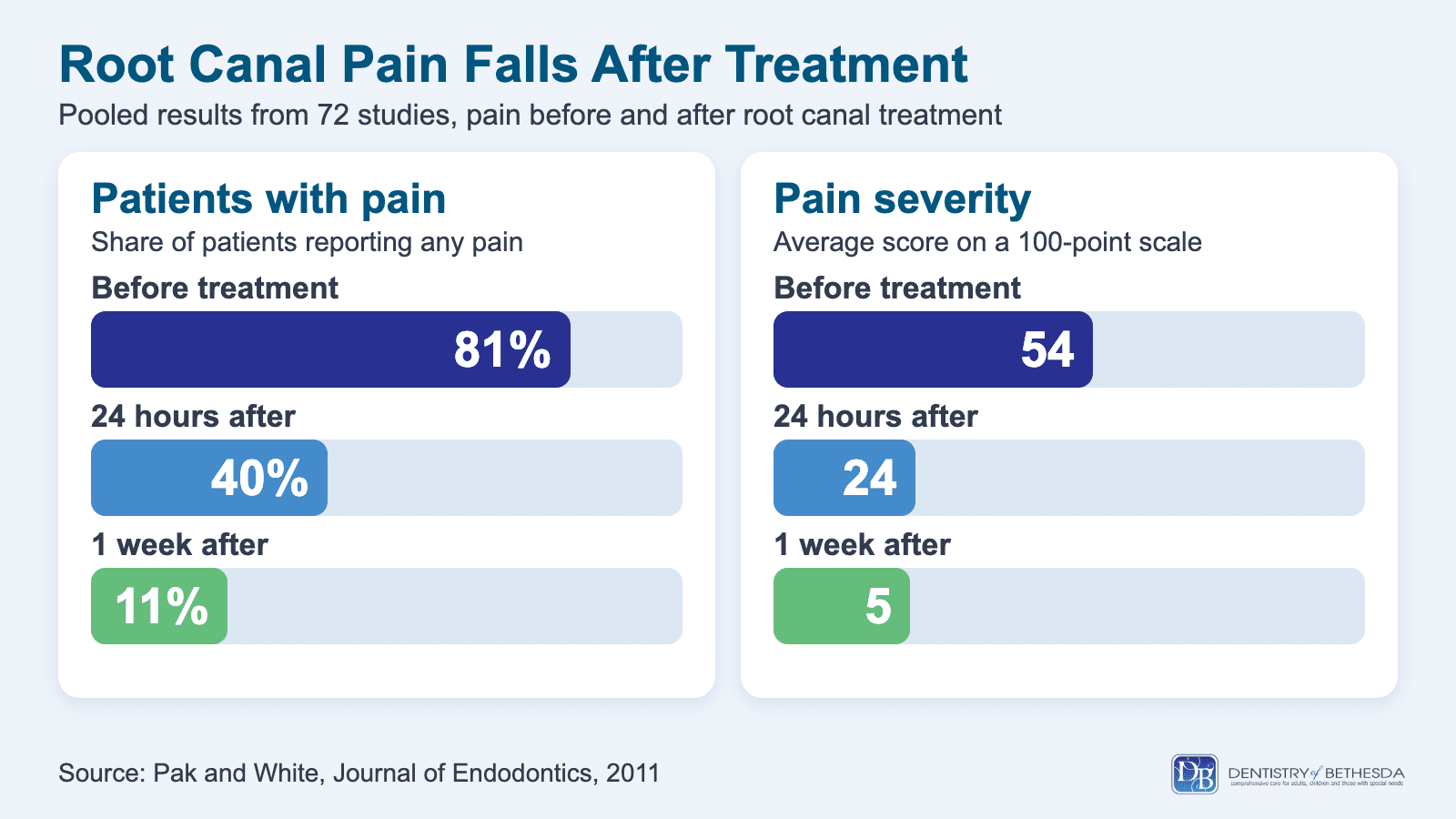
A root canal hurts less than the infected tooth, with severity dropping from 54 to 24 out of 100 in 24 hours. Pak and White analyzed 72 studies in the Journal of Endodontics in 2011. Severity reached 5 at 1 week.
The same review measured how many patients had any pain. Prevalence fell from 81% before treatment to 40% at 24 hours and 11% at 1 week. The chart below plots prevalence and severity at the three time points.
What’s the Worst Part About a Root Canal?
The worst part about a root canal is the pain before treatment, when severity averaged 54 on a 100-point scale. Pak and White also call anticipation of root canal pain a major source of patient fear. The ADA says dentists numb the tooth and surrounding area before starting.
Patients with dental anxiety can raise it with the dentist before the visit. The ADA says dentists may offer sedatives as gas, pills, or injections. The next section covers what happens when numbing falls short.
Why Does a Root Canal Sometimes Hurt During Treatment?
A root canal sometimes hurts during treatment because the first dose of numbing medicine does not always reach every nerve. Pak and White reported that supplemental injections were frequently required, with a mean of 60% across studies. The dentist can add anesthetic and wait for it to work.
Patients should say so right away when they feel sharp pain. The ADA describes nitrous oxide as a gas that helps patients feel comfortable. Its effects wear off soon after the mask is removed. Our office offers nitrous sedation for patients who want that option.
Is a Root Canal Worse Than a Filling?
A root canal is not worse than a filling in the chair, because both use local anesthesia, according to the ADA. The difference is length and aftercare. A root canal removes the pulp and takes 1 or 2 visits, while a filling treatment repairs decay without removing the pulp.
Soreness afterward is also different. The ADA says a root-canal-treated tooth may feel sensitive for a few days. The follow-up visit then replaces the temporary filling with a regular filling or a crown.
What Hurts Worse, Having a Tooth Pulled or a Root Canal?
Having a tooth pulled and having a root canal both use anesthesia, so neither procedure should hurt while the area is numb. No trial in the studies reviewed here compared the two directly. The ADA states that root canals repair and save a tooth instead of removing it.
Is It Better to Just Pull a Tooth or Get a Root Canal?
A root canal is better than pulling a restorable tooth, because 97% of treated teeth stayed in the mouth at 8 years. Salehrabi and Rotstein tracked 1,462,936 teeth in a 2004 Journal of Endodontics study. The NHS notes that an infected tooth left untreated may need to be taken out.
How Long Does a Root Canal Take?
A root canal takes 1 to 2 hours per appointment, and sometimes longer, according to the NHS. The ADA says treatment usually needs 1 or 2 office visits. Tooth type, infection, and the number of canals change the total time.
Each step of the visit has a job. The table below lists the ADA steps and what each one does for the tooth.
The next section answers how many visits those steps need.
How Many Visits Does a Root Canal Need?
A root canal needs 1 or 2 office visits, according to the ADA. The NHS says it usually takes 2 or more appointments. A Cochrane review of 47 studies found no difference in radiological failure between single-visit and multiple-visit treatment.
The same Cochrane review found more patients reported pain within 1 week after single-visit treatment, with a risk ratio of 1.55. Treatment length alone did not change healing. A final crown or filling visit follows in either case.
Why Do Molars Take Longer Than Front Teeth?
Molars take longer than front teeth because back teeth have more roots and canals to clean. A 2006 Journal of Endodontics review of 8,399 maxillary first molars found two canals in the mesiobuccal root in 56.8%. Each extra canal adds cleaning and filling time.
How Is a Root Canal Done Step by Step?
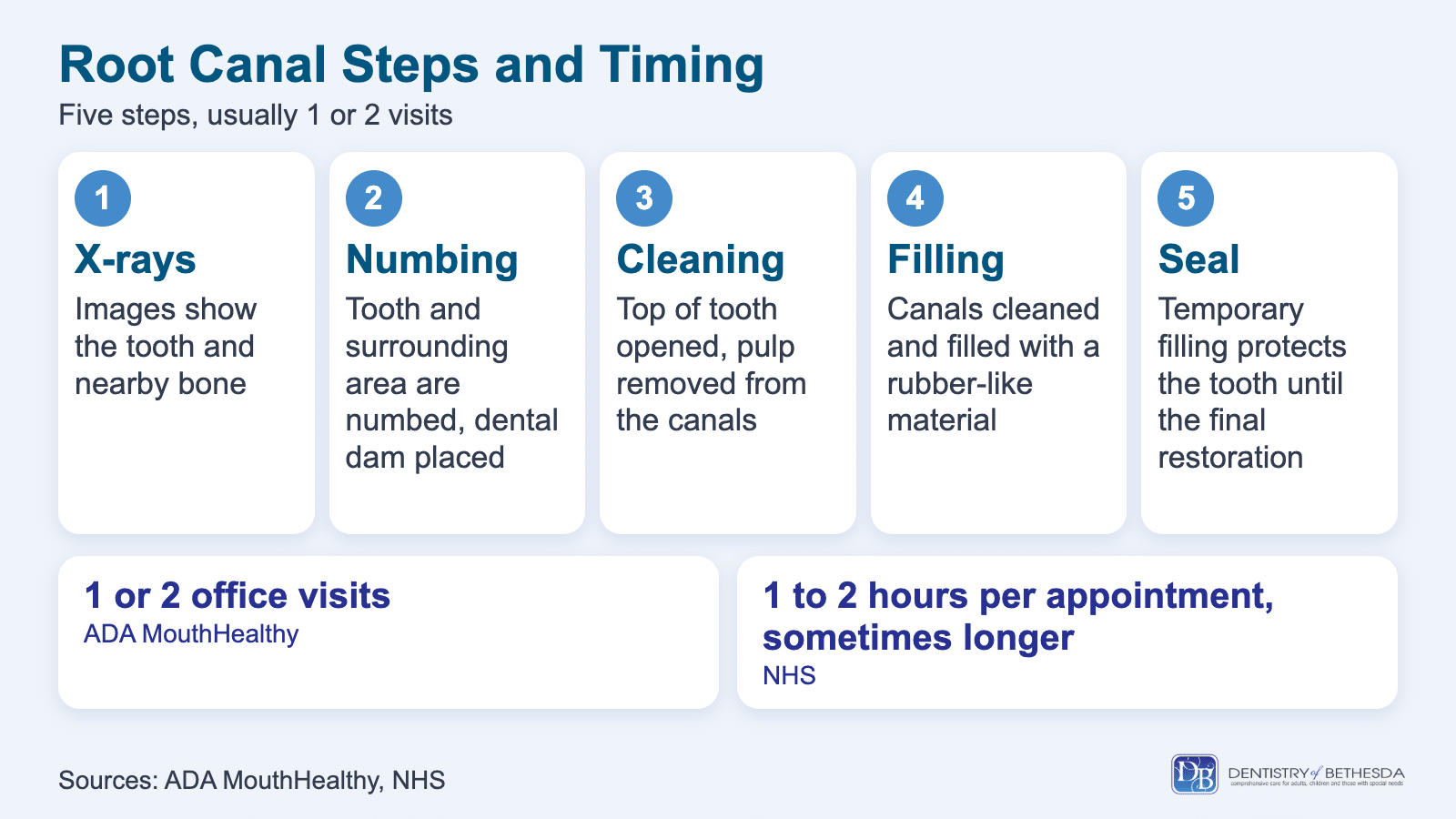
A root canal is done in five main steps that remove infected pulp and seal the tooth, according to the ADA. The numbered list below gives the order a dentist follows.
- Take X-rays of the tooth and surrounding bone.
- Numb the tooth and place a rubber dental dam.
- Open the top of the tooth and remove the pulp from the canals.
- Clean the canals and fill them with a rubber-like material.
- Place a temporary filling until the final restoration.
The graphic below shows the same sequence with the visit counts from the ADA and NHS.
How Long Does Pain Last After a Root Canal?
Pain after a root canal fades fast, with prevalence falling from 40% at 24 hours to 11% at 1 week. The NHS says swelling and soreness around the tooth should get better in a couple of weeks. Pak and White measured severity of 5 out of 100 at 1 week.
What Is Normal Pain After a Root Canal?
Normal pain after a root canal is mild soreness and sensitivity, according to the ADA. The numbness fades after several hours, the NHS adds. Swelling around the tooth should settle in a couple of weeks.
What Can You Take for Pain After a Root Canal?
Patients can take ibuprofen or acetaminophen for pain after a root canal, according to the ADA. The NHS lists paracetamol or ibuprofen. The limits below come from MedlinePlus and the FDA.
- Ibuprofen: 6 doses in 24 hours, spaced 4 to 6 hours apart (MedlinePlus)
- Acetaminophen: no more than 4,000 mg in 24 hours (FDA)
- Stronger medicine: only when the dentist prescribes it
Patients with health conditions should ask the dentist or pharmacist before choosing a pain reliever.
What to Eat After a Root Canal?
What to eat after a root canal is soft food, according to the Penn Dental Family Practice. Mouth tissues stay sensitive for a few days. The ADA says a temporary filling protects the tooth until the final restoration is placed.
Yogurt, eggs, mashed potatoes, and soup need little chewing. Hard or sticky food waits until the dentist says the tooth is ready.
Can You Drive After a Root Canal?
You can drive after a root canal with local anesthesia alone, because it numbs one area of the mouth, per the ADA. The NHS notes numbness can last several hours. The ADA says sedatives may be inhaled, taken as pills, or injected, so patients should ask the dentist about driving.
When Is Pain After a Root Canal a Warning Sign?
Pain after a root canal is a warning sign when it throbs, swells, or lasts beyond weeks, so call the dentist. Nixdorf and colleagues reviewed 26 studies in 2010. Persistent pain at 6 months or more occurred in 5.3% of teeth.
Do You Need a Crown After a Root Canal?
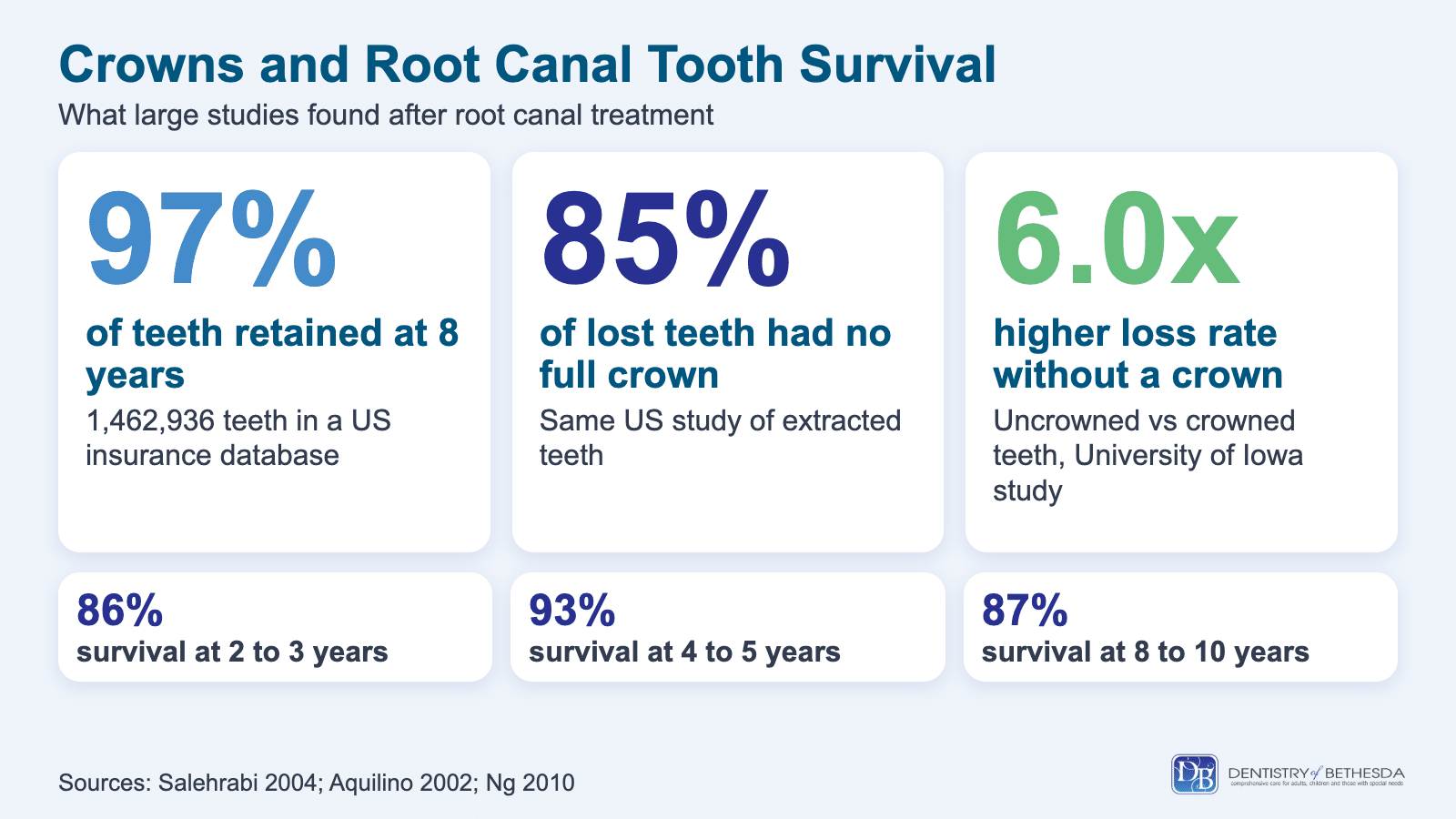
Many teeth need a crown after a root canal, because crowned teeth survive longer in the research. Aquilino and Caplan found uncrowned teeth were lost at 6.0 times the rate of crowned teeth. The NHS says a crown may be needed when the tooth was badly infected. A tooth crown covers and protects the tooth.
The ADA says the dentist replaces the temporary filling with a regular filling or a crown at a follow-up visit. Salehrabi and Rotstein found 85% of extracted teeth had no full coronal coverage. The chart below pulls those figures together.
Can You Eat Normally With a Crown?
You can eat normally with a crown once it is placed, because the crown restores the tooth, per the ADA. The dentist sets any limits for the first day. Patients can find answers in these crown questions answered by our office.
What Happens Years After a Root Canal?
Years after a root canal, treated teeth stay in place, with 97% retained at 8 years in a large US database. Ng and colleagues pooled 14 studies in 2010. Survival was 86% at 2 to 3 years, 93% at 4 to 5 years, and 87% at 8 to 10 years.
What Happens 10 Years After a Root Canal?
Ten years after a root canal, 87% of teeth survived at 8 to 10 years in the Ng systematic review. The ADA says a restored tooth can last a lifetime with twice-daily brushing, daily cleaning between teeth, and regular dental visits. Salehrabi and Rotstein found most untoward events occurred within 3 years.
What Are the Pros and Cons of Root Canals?
The pros and cons of root canals center on saving the natural tooth versus extra visits and a crown. The table below sets each point beside its source.
Those tradeoffs lead many patients to ask about alternatives.
What Are the Alternatives to a Root Canal?
The alternatives to a root canal are vital pulp therapy such as pulpotomy, or removing the tooth. The NHS says an infected tooth left untreated may need to be taken out. Both options depend on the dentist’s exam of the tooth.
What Is the New Procedure Instead of a Root Canal?
Pulpotomy removes only the top part of the pulp, and 86% of pulpotomies succeeded in a 2022 meta-analysis. The Scientific Reports review pooled 11 studies of teeth with irreversible pulpitis. Dentists choose it only for selected teeth.
Removing the tooth is the other route. Missing teeth then need replacement, so many patients compare implant options with saving the natural tooth.
When Is It Too Late to Avoid a Root Canal?
Avoiding a root canal is unlikely once decay or a crack hits the pulp, because the ADA lists both as infection causes. The ADA says untreated infection can spread to tissues around the root. Pain, swelling, and an abscess signal that stage.
At What Point Is It Too Late for a Root Canal?
A root canal is too late when the dentist finds the tooth cannot be restored, so removal becomes the option. The ADA warns that bacteria can damage the bone that holds the tooth to the jaw. A prompt exam keeps the choice open.
Why Do Dentists Try to Avoid Root Canals?
Dentists try to avoid root canals by treating decay early, since a deep cavity is a listed cause of pulp infection. The ADA names deep cavities, cracks, repeated dental work, and injury. Watching for early decay signs lets dentists treat decay sooner.
What Else Should You Know About Root Canals?
What Are the First Signs of Needing a Root Canal?
The first signs of needing a root canal are pain and swelling, according to the ADA. An abscess can form in the tooth or in the bone near the root. Patients can compare symptoms with these toothache options from our office.
Why Do People Say to Never Get a Root Canal?
People say to never get a root canal because of focal infection theory, which researchers eventually refuted for lack of controlled evidence. A 2022 review in Medicina describes the early 1900s theory. The same review reports emerging evidence that infection at the root tip may add to systemic inflammation.
Does a Root Canal Hurt on a Dead Tooth?
A root canal on a dead tooth still uses anesthesia, because infection around the root causes pain and swelling, per the ADA. The dentist numbs the area and cleans the canals.
How Does Dr. Hornstein Help With Root Canal Pain?
Dr. Hornstein helps with root canal pain by numbing the tooth, cleaning the canals, and sealing it. We provide root canal therapy and retreatment. Our Bethesda office also welcomes patients with special needs and seniors.
Patients with a throbbing tooth or facial swelling can call (301) 530-2700 for an exam. We plan the follow-up restoration at the same time, so the tooth is protected between visits. Each appointment starts with an explanation of the next step.
The team at Hornstein’s dental care welcomes questions at any point before, during, and after treatment.