

The best medicine for toothache is an over-the-counter NSAID such as ibuprofen, per the American Dental Association (ADA). Acetaminophen can be added. An NSAID stands for nonsteroidal anti-inflammatory drug. Adult labels allow up to 6 ibuprofen tablets of 200 mg in 24 hours. The FDA caps acetaminophen at 4,000 mg per day. Medicine eases pain only and never treats the cause.
Key Takeaways
- The ADA guideline names NSAIDs, alone or with acetaminophen, as first-line medicine for temporary toothache pain.
- Ibuprofen labels allow 6 doses in 24 hours, and acetaminophen stops at 4,000 mg per day for ages 12 and up.
- Naproxen is taken every 8 to 12 hours, and it should never be mixed with ibuprofen or aspirin.
- Children need weight-based doses, and benzocaine gels are not for children under 2.
- Pain past two days, swelling, or fever means a dentist visit, because medicine cannot fix the tooth.
What Is the Best Medicine for Toothache?
The best medicine for toothache is an NSAID such as ibuprofen or naproxen, with or without acetaminophen. The ADA guideline published in JADA in February 2024 calls nonopioid medications first-line for temporary toothache management. The guideline covers adolescents, adults, and older adults when definitive dental care is not immediately available.
The ADA, the University of Pittsburgh, and the University of Pennsylvania wrote the guideline. The panel found that NSAIDs alone or with acetaminophen likely give superior relief with a more favorable safety profile than opioids. Our general dentistry team treats the cause once the pain is under control.
The table below compares the over the counter medicine for toothache that the sources name. Each row shows how the drug works and the main limit from the source. The next section sorts these options for adults.
The table shows two drug families, NSAIDs and acetaminophen. Each family has its own daily limit. The limits for adults matter first.
What Medicine Can Adults Take for a Toothache?
What medicine to take for toothache starts with three options. Adults can take ibuprofen, naproxen, or acetaminophen as toothache medicine for adults. The ADA lists NSAIDs alone or with acetaminophen as the preferred choice for age 12 and older. The ADA answers what medicine is good for toothache by naming NSAIDs first, because they reduce inflammation.
The ADA states that standard over-the-counter strengths are 200 mg for ibuprofen and 325 or 500 mg for acetaminophen. MedlinePlus lists naproxen for toothaches on its nonprescription label. Each drug below fits a different situation.
- Ibuprofen suits throbbing pain with gum or cheek swelling.
- Naproxen suits adults who prefer fewer doses per day.
- Acetaminophen suits adults who must avoid NSAIDs.
- The ibuprofen and acetaminophen pair suits pain that one drug leaves untouched.
The pair raises the question of strength. The strongest option needs a clear definition.
What Is the Strongest Over the Counter Toothache Medicine?
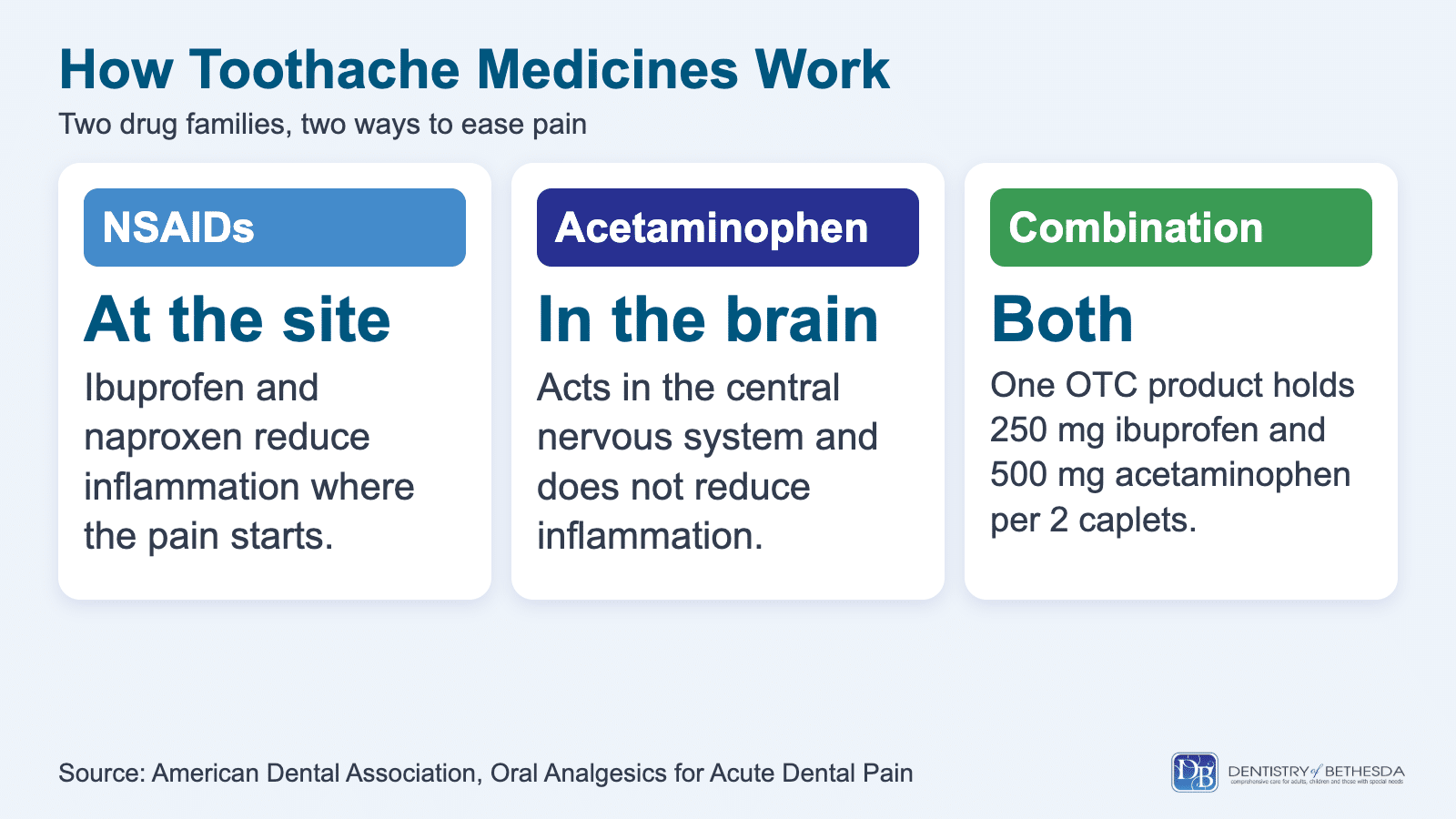
The strongest toothache medicine over the counter is ibuprofen taken with acetaminophen. The ADA reports that the combination is highly effective for mild to moderate pain. NSAIDs act at the site of inflammation, while acetaminophen acts in the central nervous system.
The FDA approved a single over-the-counter product in 2020 that contains both drugs. According to the ADA, each 2-caplet dose holds 250 mg of ibuprofen and 500 mg of acetaminophen. The ADA guideline also found NSAIDs more effective than opioids for toothache.
The strongest option still treats pain only. Choosing between the two single drugs is the next question.
Is Ibuprofen or Acetaminophen Better for a Toothache?
Ibuprofen is better for a toothache with inflammation, while acetaminophen is the option when NSAIDs are unsafe. That makes ibuprofen the NSAID pick for a toothache with swelling. The ADA guideline names NSAIDs, alone or with acetaminophen, as first-line for toothache from pulp or periapical disease. Inflammation around the tooth root drives that pain.
The ADA explains that acetaminophen acts centrally, while NSAIDs act at the site of inflammation. Adults with stomach ulcers, kidney disease, or certain heart conditions may need that option instead. Spotting decay warning signs early limits the need for medicine. A pharmacist or doctor confirms the right medicine for a toothache for each person.
The right drug still needs the right amount. The label limits come next.
How Much Medicine Can You Take for a Toothache?
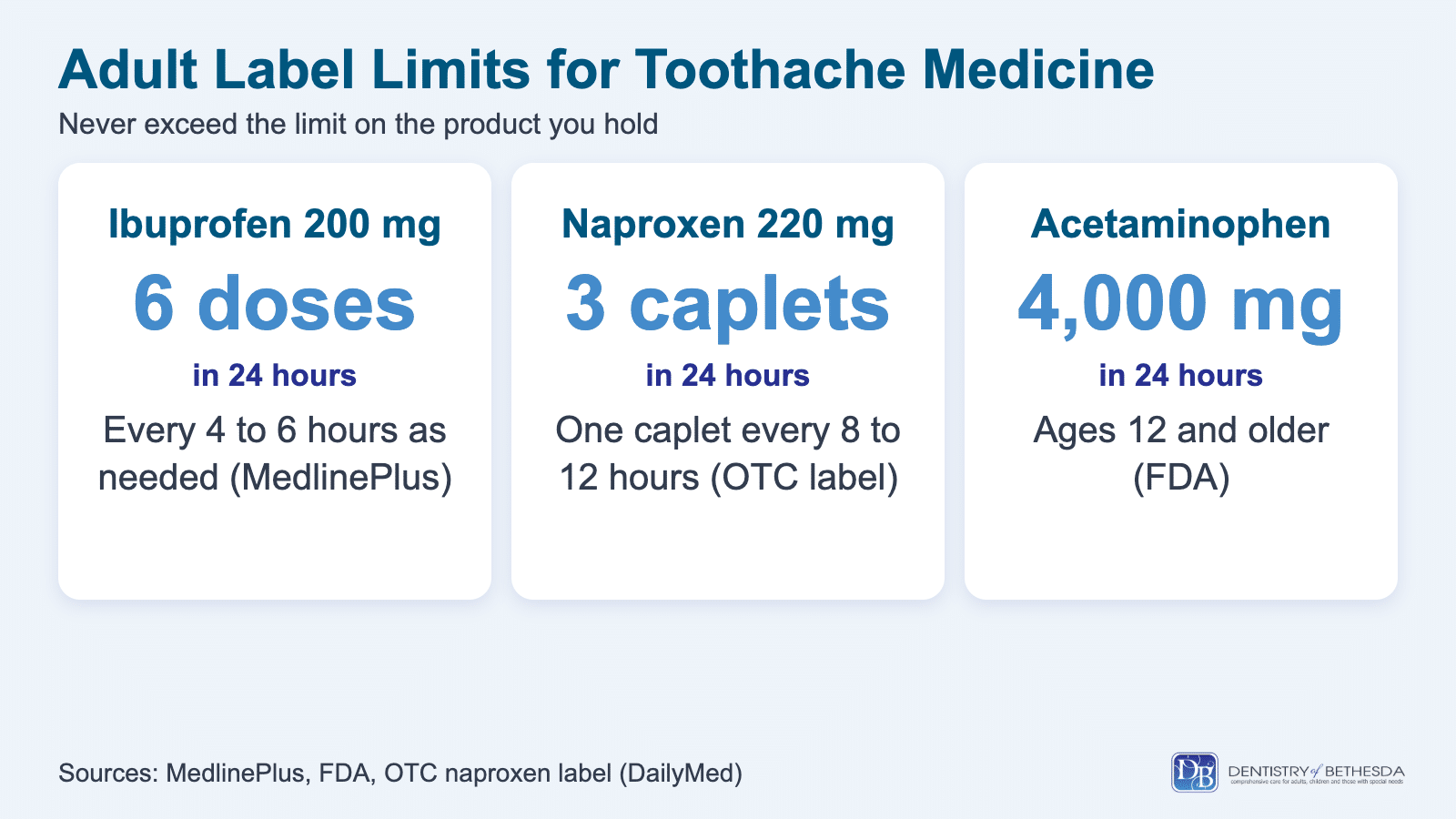
You can take toothache medicine only up to the label limit for each drug. The FDA states that acetaminophen must not exceed 4,000 mg in 24 hours for adults and children 12 and older. Ibuprofen and naproxen have their own limits.
The table below lists the adult limits from MedlinePlus, the FDA, and an over-the-counter naproxen label. A dose chart helps prevent accidental overdose. Read the label on the product you own.
The limits come from separate sources, so each product label still rules. The graphic below shows the same limits side by side. Follow the steps after it to stay inside them.
- Read the active ingredient and strength on the label.
- Take one dose and write down the time.
- Wait the full interval before the next dose.
- Count every product that holds acetaminophen, including cold medicine.
- Stop at the 24-hour limit and call a dentist or doctor.
The steps cover the basics for any drug. Ibuprofen has its own details.
How Much Ibuprofen Can You Take for a Toothache?
You can take ibuprofen for a toothache every 4 to 6 hours, with no more than 6 doses in 24 hours. MedlinePlus gives that limit for adults and children older than 12. A typical over-the-counter label allows 2 tablets of 200 mg if 1 tablet does not help.
MedlinePlus advises stopping ibuprofen and calling a doctor when pain lasts more than 10 days. An NSAID can raise the chance of a heart attack or stroke, according to the same page. Naproxen offers another NSAID choice.
Is Naproxen Good for a Toothache?
Naproxen is good for a toothache, and MedlinePlus lists toothaches on the nonprescription naproxen label. Adults take one 220 mg caplet every 8 to 12 hours with a full glass of water. The label allows no more than 3 caplets in 24 hours.
The label permits 2 caplets for the first dose within the first hour. MedlinePlus advises taking naproxen with food or milk to prevent nausea. Naproxen must not be combined with ibuprofen or aspirin, because all three are NSAIDs.
Can You Take Ibuprofen and Acetaminophen Together for a Toothache?
You can take ibuprofen and acetaminophen together for a toothache, because the two drugs work in different ways. The ADA guideline supports an NSAID alone or with acetaminophen for temporary toothache relief. Each drug keeps its own daily limit.
Taking extra tablets of either drug does not add safe relief. The FDA warns that too much acetaminophen can cause liver failure and death. Keep a written log of every dose and its time.
Adults are not the only readers asking about dosing. Parents ask about children next.
What Medicine Can Kids Take for a Toothache?
Kids can take weight-based ibuprofen or acetaminophen as toothache medicine for kids, as the label directs. The ADA children’s guideline recommends ibuprofen or naproxen, alone or with acetaminophen, for temporary toothache management in children under 12. The evidence certainty is very low, and the recommendation is conditional.
The American Academy of Pediatrics (AAP) states that a child’s weight decides the amount. The AAP lists acetaminophen every 4 hours for children under 12, with no more than 5 doses in 24 hours. Ibuprofen is given every 6 to 8 hours and not under 6 months of age unless a doctor says so.
The ADA notes that the FDA contraindicates codeine and tramadol in children for acute pain. Our pediatric dentistry care starts with a gentle exam to find the cause of the pain. Some medicines suit certain people less well, which the next section sorts out.
Who Should Avoid Which Toothache Medicine?
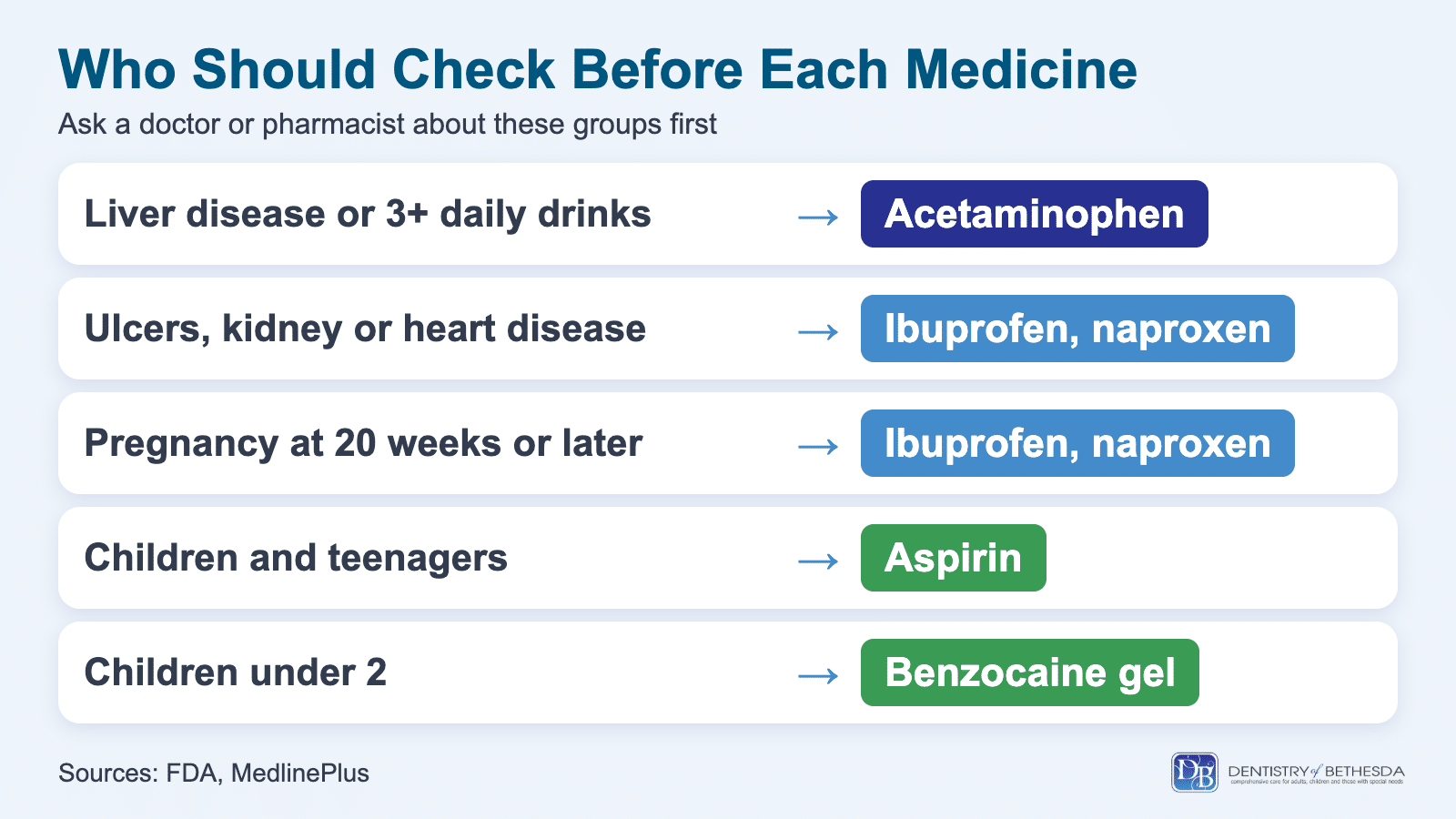
People with liver, stomach, kidney, or heart conditions should avoid certain toothache medicines. MedlinePlus says tell your doctor about ulcers, kidney disease, or liver disease before taking ibuprofen, naproxen, or aspirin. The table below matches each group with the drug to question.
The table lists five groups with five different cautions. Three groups need a closer look, starting with pregnancy.
Can You Take Ibuprofen for a Toothache While Pregnant?
You should not take ibuprofen for a toothache around or after 20 weeks of pregnancy unless a doctor says so. MedlinePlus states that ibuprofen may harm the fetus and cause problems with delivery after that point. The same warning applies to naproxen.
Pregnant patients should call a doctor and a dentist before taking any medicine. The FDA states that any medicine in pregnancy should be carefully considered. Aspirin has its own cautions.
Can You Take Aspirin for a Toothache?
You can swallow aspirin for a toothache as an adult, but never place it on the tooth or gum. The ADA’s MouthHealthy site warns that aspirin on the gum may burn the tissue. MedlinePlus lists aspirin every 4 to 6 hours for pain.
MedlinePlus advises asking a doctor before giving aspirin to a child or teenager. Aspirin may cause Reye’s syndrome, especially with a virus such as chicken pox or flu. Topical gels raise a separate safety question.
Is Benzocaine Gel Safe for a Toothache?
Benzocaine gel is not safe for children under 2 years old, according to the FDA. The agency warned in 2018 that oral benzocaine products carry a risk of methemoglobinemia, a serious blood disorder. Signs include pale, gray, or blue skin, lips, or nail beds, and shortness of breath.
The signs can appear within minutes to 1 or 2 hours after use. Anyone with those signs needs emergency care at once. Medicine that fails to ease pain points to a bigger problem.
Why Does a Toothache Not Go Away With Painkillers?
A toothache does not go away with painkillers when decay, infection, or a cracked tooth keeps causing the pain. Cleveland Clinic states that painkillers and antibiotics are temporary and infection returns unless the underlying problem is treated. Medicine lowers symptoms only.
The CDC reports that 20.5% of dentate adults aged 20 to 64 had untreated tooth decay. The data cover permanent teeth from 2017 to March 2020. Untreated decay can reach the nerve and cause a lasting ache. A cavity treatment plan removes the source.
Dentists use fillings or root canal therapy when decay reaches the pulp. Our root canal treatment page explains that process. Several related questions follow in the next section.
What Else Should You Know About Toothache Medicine?
What Do Dentists Prescribe for Severe Tooth Pain?
Dentists prescribe an NSAID first, and opioids only when first-line medicine fails. The ADA guideline says opioids are reserved for cases where first-line therapy is insufficient or NSAIDs are contraindicated. The guideline advises avoiding routine just-in-case opioid prescriptions.
The panel urged extreme caution with opioids in adolescents and young adults. A dentist also treats the cause with a filling, root canal, or extraction. Antibiotics raise a related question.
Can You Get Antibiotics for a Tooth Infection Without Seeing a Dentist?
You cannot get antibiotics for a tooth infection safely without a dental exam. Cleveland Clinic states that antibiotics are temporary and do not fix the tooth. A dentist confirms the infection and removes its source.
Swelling in the face or jaw needs care the same day. A routine dental exam can find a problem tooth before pain starts. Duration limits matter for medicine too.
How Long Can You Take Painkillers for a Toothache?
You can take nonprescription painkillers for a toothache for up to 10 days at most. MedlinePlus tells readers to stop ibuprofen and call a doctor when pain lasts more than 10 days. Cleveland Clinic advises a dentist call after two days.
Two days is the safer call point for a toothache. Longer pain signals decay or infection that medicine cannot clear. Duration of the ache itself also matters.
How Long Do Toothaches Usually Last?
A toothache from gum irritation goes away in a day or two, according to Cleveland Clinic. A cavity or abscess will not go away completely without treatment. Pain past two days needs a dentist.
The cause decides the timeline, not the medicine. A visit is the next step after two days.
When Should You See a Dentist for a Toothache?
You should see a dentist for a toothache that lasts longer than two days, according to Cleveland Clinic. Swelling in the face or jaw and pain when opening the mouth wide also call for a dentist right away. Read about our toothache treatment options for the next steps.
Cleveland Clinic sends patients to the emergency room for swelling below the eye or a knot on the jaw. A fever over 101 degrees F or unbearable pain that medicine does not ease also needs the ER. Bleeding that will not stop with pressure is another sign.
Frequently Asked Questions
Can You Mix Cold Medicine With Toothache Medicine?
You should check the cold medicine label first, because many cold and flu products contain acetaminophen. The ADA states that over 4,000 mg of acetaminophen per day is associated with acute liver failure. Count every acetaminophen product toward the limit.
Can You Drink Alcohol While Taking Acetaminophen?
You should not take acetaminophen with three or more alcoholic drinks per day, according to the FDA. Severe liver damage may occur at that level. Ask a doctor about safe alcohol use before taking it.
Can You Take Naproxen and Ibuprofen Together?
You should not take naproxen and ibuprofen together, according to MedlinePlus. Both are NSAIDs, and the page lists ibuprofen and aspirin as products that interact with naproxen. Pick one NSAID and add acetaminophen if needed.
Should You Take Naproxen With Food?
You may take naproxen with food or milk to prevent nausea, according to MedlinePlus. The page also says to take it with a full glass of water. Stomach pain that does not improve needs a doctor.
Is Ibuprofen Safe for People With Heart Disease?
People with heart disease should ask a doctor before taking ibuprofen. MedlinePlus states that NSAIDs may raise the risk of a heart attack or stroke. Chest pain or weakness on one side needs emergency help right away.
How Does Dentistry of Bethesda Help With Toothache Pain?
We help with toothache pain by finding the cause and treating it. Treatment can include a filling, a root canal, or other care, depending on the cause.
Families in Bethesda can request a time through our schedule a visit page. The team confirms the earliest opening for pain. Patients describe the pain, its length, and the medicine already taken.
Dr. Hornstein examines the tooth, takes the needed images, and explains the options. The visit ends with a clear plan for the next appointment. A written plan lists the dose limits that still apply until treatment starts.
Regular checks catch trouble early, and our preventive dentistry services support that goal. The team reviews diet, brushing, and flossing with each patient. Small changes lower the chance of a painful surprise.
Patients can meet Dr. Spencer Hornstein and the team before the first visit.