

A routine dental cleaning without insurance costs $75 to $200, according to WebMD. GoodRx reports a national average near $200, citing CareCredit, and some practices charge more than $300. Deep cleanings are billed by section of the mouth and can total $1,500 or more. The final bill depends on the visit type, the dentist, the location, and any added services.
Key Takeaways
- WebMD puts a routine cleaning without insurance at $75 to $200.
- WebMD lists a dental exam and cleaning together at $200 or more.
- WebMD gives $150 to $350 for a deep cleaning, with anesthesia costing extra.
- Dental savings plans discount network fees by 10%-60%, according to WebMD.
- NIDCR points to dental schools and federally funded health centers for lower-cost care.
How Much Is a Dental Cleaning Without Insurance?
A dental cleaning without insurance costs $75 to $200 for a routine visit, according to WebMD. GoodRx reports a national average of about $200, citing CareCredit. Each practice sets its own fees, so the final number varies by office.
Searches for how much for a dental cleaning without insurance return a range, not one price. GoodRx says X-rays or fluoride treatments can raise the cost of a visit. Our team explains what each of our cleaning visits includes before treatment starts.
The table answers how much is a dental cleaning without insurance by visit type. The table uses national ranges from WebMD and GoodRx.
These figures are national ranges, so a local quote can fall above or below them. The chart below shows the same ranges side by side.
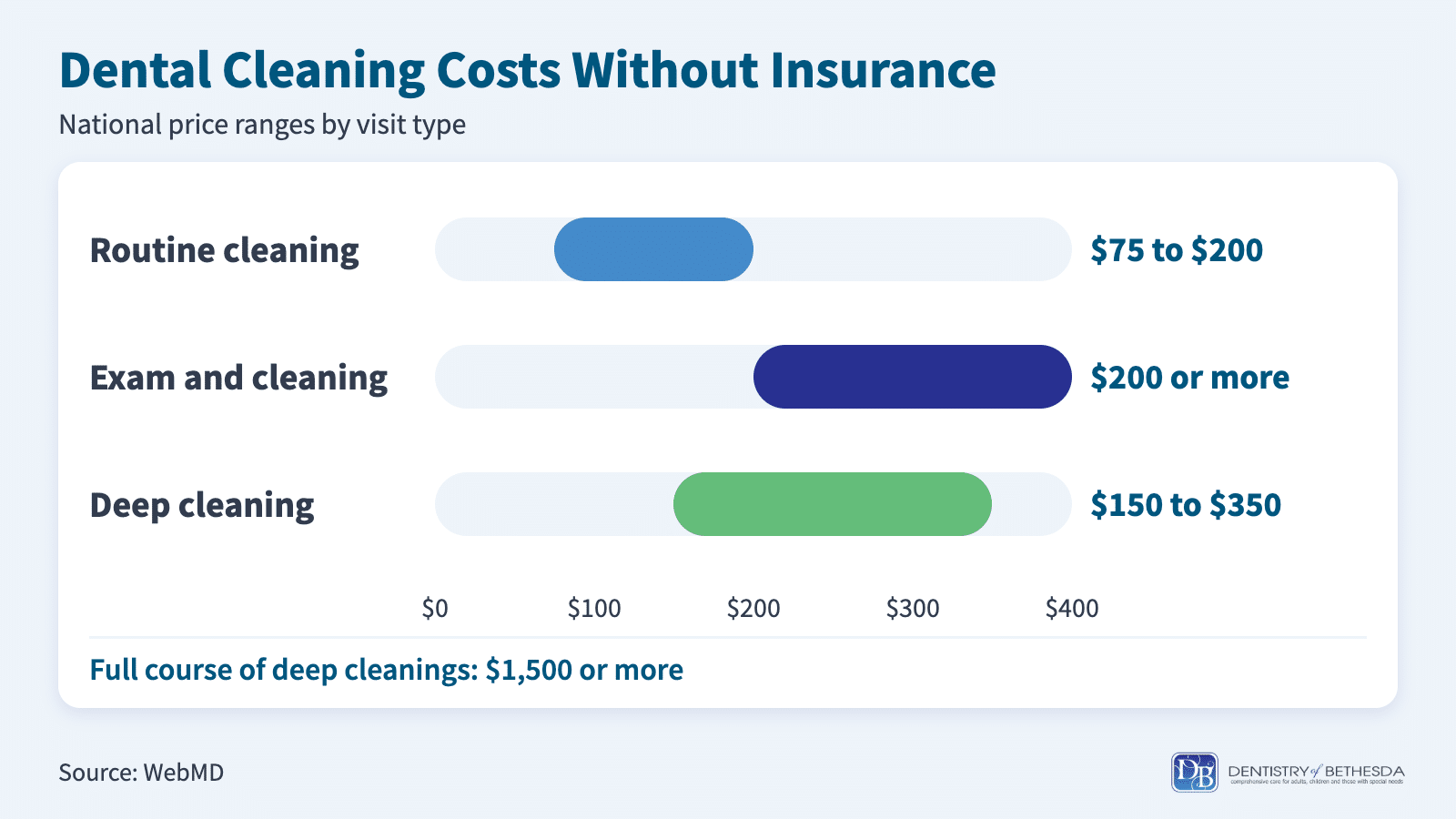
How Much Is a Routine Dental Cleaning Without Insurance?
A routine dental cleaning without insurance usually costs between $75 and $200, according to WebMD. WebMD ties the exact price to location, dentist, cleaning type, and the condition of your teeth.
GoodRx adds that some practices charge more than $300 for a basic cleaning. The dental cleaning price without insurance therefore spans from $75 up to more than $300 across these two sources. Dental cleaning costs without insurance also reflect what a visit includes, which leads to the exam question.
How Much Is a Dental Exam and Cleaning Without Insurance?
A dental exam and cleaning without insurance costs $200 or more, according to WebMD. WebMD says dentists can charge $200 or more for a routine cleaning and exam together.
GoodRx lists X-rays and fluoride treatments as extras that can increase the cleaning visit price. WebMD reports that a dental visit without insurance ranges from about $75 to several thousand dollars. The wide spread explains why a deep cleaning sits in its own price tier.
How Much Is a Dental Deep Cleaning Without Insurance?
A dental deep cleaning without insurance costs $150 to $350, according to WebMD. WebMD adds that the price may be higher when you need anesthesia.
GoodRx lists $150 to $300 per session, and says treatment may take more than one visit. WebMD says deep cleanings are usually done on one-fourth of the mouth per session. A full course can total $1,500 or more, per WebMD.
What Is the Difference Between a Routine Cleaning and a Deep Cleaning?
A routine cleaning differs from a deep cleaning because a deep cleaning goes under the gums. WebMD describes a deep cleaning as different from the regular cleaning many patients get twice a year.
GoodRx explains that a deep cleaning removes tartar below the gum line and treats inflamed gums. NIDCR says a dentist may perform root planing, a deep cleaning of the affected tooth, for periodontal disease.
What Affects the Price of Dental Cleaning Without Insurance?
The price of dental cleaning without insurance depends on location, the dentist, the type of cleaning, and the condition of your teeth. WebMD names these four drivers, and GoodRx adds more.
- Location: GoodRx says rural areas can add fuel, transportation, and time off work to the true cost.
- Dentist: GoodRx lists the dentist’s level of experience as a factor.
- Cleaning type: GoodRx separates a routine cleaning from a deep cleaning, which costs more.
- Time since the last visit: GoodRx says a long gap may require more rigorous treatment.
- Added services: GoodRx says X-rays or fluoride treatments can increase the visit price.
The question of how much for dental cleaning without insurance therefore has no single answer. Asking for an itemized quote shows which line items apply to your visit. A regular teeth cleaning schedule also keeps the visit type simple.
How Can You Get a Dental Cleaning for Less Without Insurance?
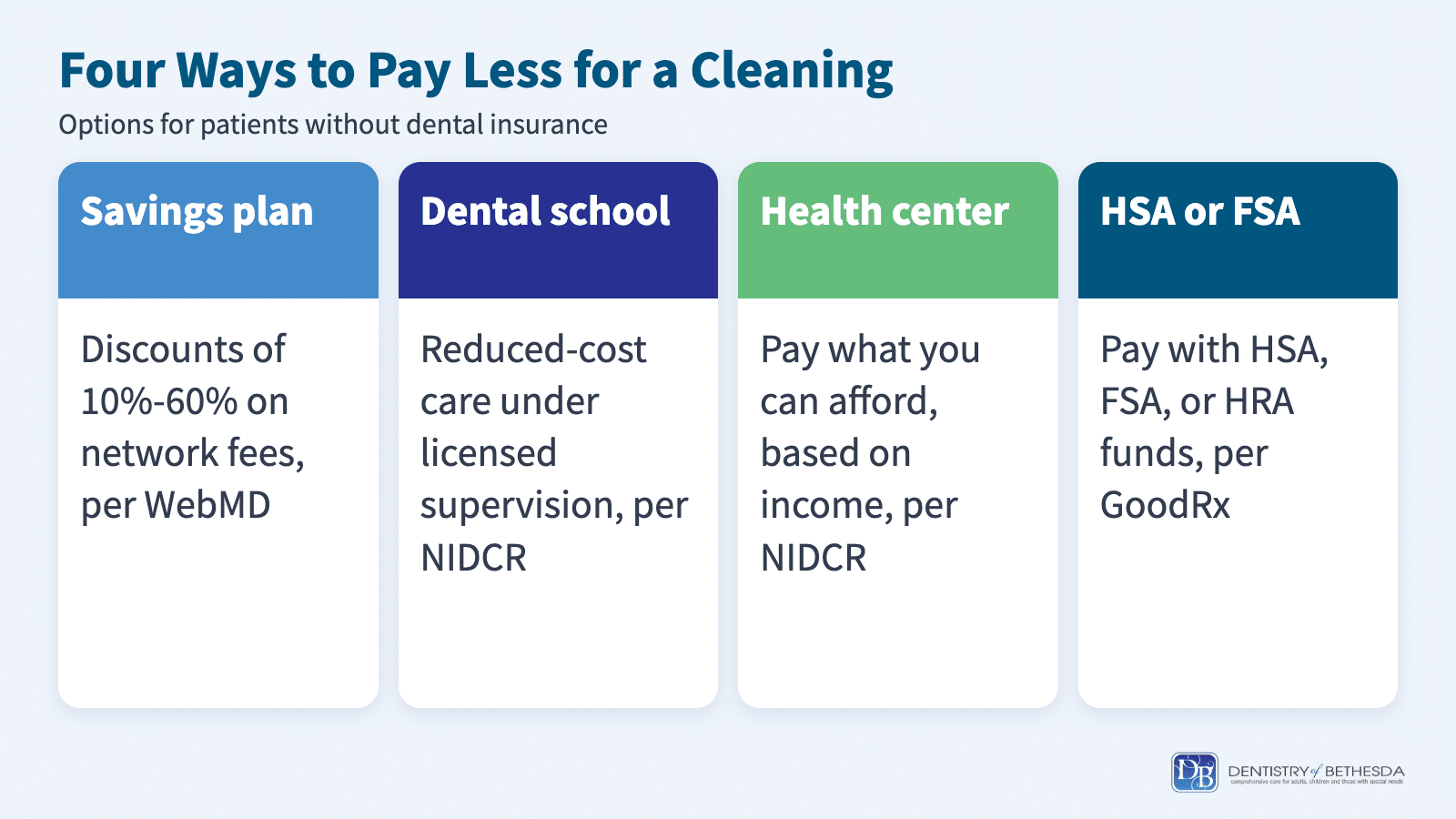
You can get a dental cleaning for less without insurance by comparing quotes, joining a savings plan, or visiting a school. Health centers are another route. WebMD, GoodRx, and NIDCR describe these options.
- Ask each office for its self-pay price for the cleaning, exam, and X-rays.
- Ask whether the practice offers a payment plan or a membership program, as WebMD suggests.
- Compare dental savings plans, which WebMD says discount network fees by 10%-60%.
- Contact a dental school or dental hygiene school clinic, as NIDCR advises.
- Search for a federally funded health center on the Health Resources and Services Administration website, per NIDCR.
- Pay with HSA, FSA, or HRA funds when you have them, according to GoodRx.
Knowing what a new patient visit includes makes quotes easier to compare. The graphic below shows four of these options and who describes them.
Are Dental Savings Plans Worth It?
Dental savings plans are worth comparing for patients without insurance because they discount network fees by 10%-60%, according to WebMD. Members pay a yearly fee, typically under $150 for a family, with no deductible.
GoodRx says a plan may take 20% to 40% off teeth cleanings in its network. GoodRx gives an example: a $100 cleaning with a 30% discount costs $70. WebMD stresses that a savings plan differs from insurance, so the discount applies right away.
Can You Get a Cheap Dental Cleaning at a Dental School?
Yes, dental school and dental hygiene school clinics offer care at reduced cost, according to NIDCR. Licensed dentists closely supervise the students who treat patients.
WebMD says patients might pay half or less for root canals and fillings at these clinics. Visits take longer because supervisors check each step. GoodRx notes that nearly 80 accredited dental schools operate in the United States.
Where Can You Find Free or Low-Cost Dental Cleanings?
Free or low-cost dental cleanings are available at federally funded health centers, according to NIDCR. At these centers you pay what you can afford, based on income. Health centers sit in most cities and many rural areas.
NIDCR also points to state and local health departments and the 2-1-1 phone line for local programs. WebMD says federally qualified health centers offer low-cost or free dental services. Eligibility covers people at or below 200% of the federal poverty level.
What Else Should You Know About Dental Cleaning Costs?
Is a Dental Cleaning Worth It Without Insurance?
A dental cleaning is worth it without insurance because only a professional cleaning removes tartar, according to NIDCR. Plaque and tartar contain bacteria that can trigger inflammation, which damages the gums and supporting tissues.
GoodRx describes a cleaning as preventive care that costs far less than restorative procedures such as a root canal or crown. Routine visits also bring preventive benefits beyond tartar removal.
NIDCR says early gum disease, caused by plaque buildup, can often be reversed by daily brushing and flossing. Learning about gum disease prevention helps patients keep future treatment needs lower.
How Often Should You Get a Dental Cleaning?
You should get a dental cleaning at least twice a year, or as often as your dentist recommends, according to WebMD. NIDCR also lists regular check-ups and professional cleanings as part of preventing tooth decay.
NIDCR says a dentist can find tooth decay during a regular dental check-up. Many patients pair a cleaning with routine exams for that reason.
Does Medicare Cover Dental Cleanings?
Medicare does not cover dental cleanings in most cases, according to Medicare.gov. The same page lists fillings, extractions, dentures, and implants as services you pay for in most cases.
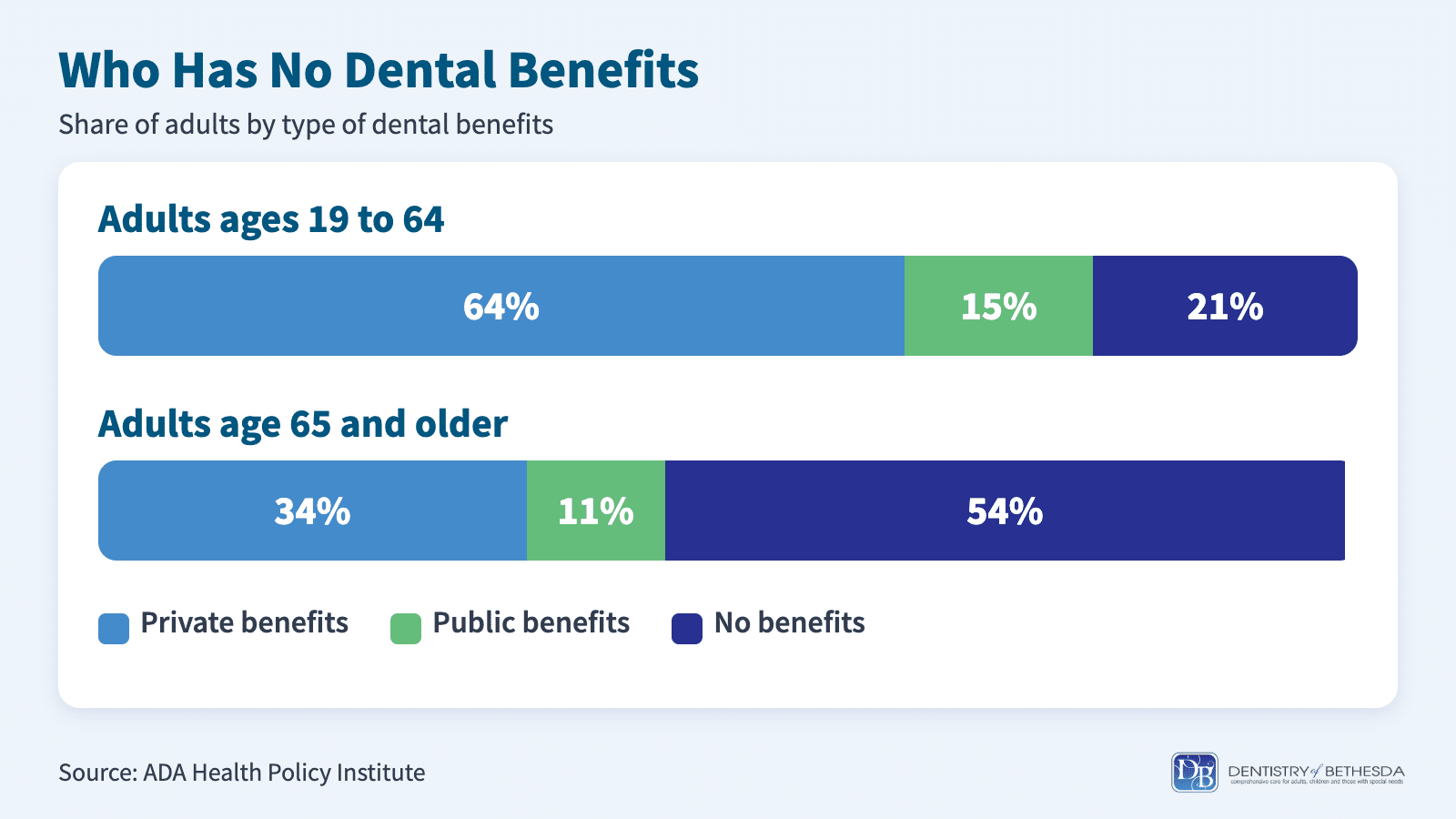
GoodRx reports that most Medicare Advantage plans do include dental coverage. The ADA Health Policy Institute reports that 54% of adults ages 65 and older have no dental benefits. That gap makes self-pay prices relevant for many seniors.
Does Medicaid Cover Dental Cleanings for Adults?
Medicaid covers dental cleanings for adults only where the state chooses to offer adult dental benefits, according to NIDCR. States must provide dental benefits for children covered by Medicaid.
NIDCR says most states provide only limited dental services for adults, while some offer extensive services. The state Medicaid program can confirm what applies to your household.
Can You Use an HSA or FSA for a Dental Cleaning?
Yes, you can use HSA, FSA, or HRA funds for a dental cleaning, according to GoodRx. HSA funds suit people enrolled in high-deductible health plans, and FSAs suit people with certain employer-sponsored plans.
GoodRx explains that an HRA reimburses expenses not covered by health insurance, and only an employer can contribute to it.
Can You Deduct Dental Cleaning Costs on Your Taxes?
Yes, teeth cleaning counts as a medical expense on your tax return, according to the IRS. Only the part above 7.5% of adjusted gross income is deductible. The deduction applies when you itemize on Schedule A.
IRS Publication 502 lists teeth cleaning, sealants, and fluoride treatments as preventive dental treatment. A tax professional can confirm how the rule applies to your return.
How Many Adults Have No Dental Insurance?
Among adults ages 19 to 64, 21% have no dental benefits, according to the ADA Health Policy Institute. Another 64% have private dental benefits, and 15% have public benefits.
The same ADA data shows 34% of adults 65 and older have private benefits and 11% have public benefits. The chart below compares the two age groups.
What Is a Full-Mouth Debridement?
A full-mouth debridement is a heavy-duty plaque and tartar removal that GoodRx says some patients need before an exam and cleaning. The cleaning and exam then happen at a later appointment.
GoodRx lists debridement as a reason a cleaning visit can cost more. A long gap since the last cleaning can lead to this extra step.
Frequently Asked Questions
Can I Get My Teeth Cleaned Without Dental Insurance?
Yes, you can get your teeth cleaned without dental insurance by paying out of pocket, according to GoodRx. Dental savings plans, dental schools, and health centers can lower the price.
Is a Deep Cleaning More Expensive Than a Regular Cleaning?
Yes, a deep cleaning is more expensive overall than a regular cleaning, according to WebMD. A routine cleaning runs $75 to $200, while a full course of deep cleanings can total $1,500 or more.
Can You Pay for a Dental Cleaning in Installments?
You can pay for a dental cleaning in installments only where the practice offers a payment plan, according to WebMD. WebMD advises asking your dentist about payment programs and membership programs with discounts.
What Happens If You Skip Dental Cleanings?
Skipping dental cleanings means tartar stays on the teeth, because only a professional cleaning removes it, according to NIDCR. Plaque and tartar bacteria can trigger gum inflammation. NIDCR says daily brushing and flossing can often reverse early gum disease, while periodontal disease needs treatment from a dentist or hygienist.
Does a Long Gap Between Cleanings Raise the Cost?
A long gap between cleanings can raise the cost because teeth may need more rigorous treatment, according to GoodRx. GoodRx names full-mouth debridement as one example.
How Does Dentistry of Bethesda Help With Dental Cleaning Costs?
Dentistry of Bethesda helps with dental cleaning costs by explaining each part of a visit before treatment begins. Dr. Hornstein and our team answer questions about what a cleaning, exam, and X-rays involve.
Patients asking how much is a dental cleaning without insurance are welcome at our office. We review what each visit involves before it begins. Questions about the process are part of every appointment.
Our team schedules cleaning appointments for adults and children. Each visit starts with a review of what the cleaning, exam, and X-rays involve. Patients can ask about any step before it happens.
The same approach applies to routine care across the practice. Our preventive care covers the visits that keep teeth healthy between treatments.
Every patient receives the same plain explanation of the exam, the cleaning, and any X-rays before they begin. Patients can ask about each step, and we answer in everyday language. Parents can ask the same questions on behalf of their children.
When a patient is ready, they can request a visit online and talk through their options.
The front desk and clinical team answer questions about each step of care before treatment begins. We also explain how often a patient should return, based on the dentist’s recommendation. Patients leave with a clear plan for their next visit.
Meeting Dr. Hornstein and the team is the simplest way to learn what your own cleaning visit includes. We look forward to welcoming you to our Bethesda practice.