

Receding gums result from gum disease, hard brushing, tobacco use, thin gum tissue, teeth grinding, tooth position, oral piercings, and hormone shifts. A Journal of the American Dental Association review found recession at one or more sites in 88% of adults 65 and older. The same review found recession at one or more sites in 50% of adults 18 to 64. Gum disease is the cause dentists check first.
Key Takeaways
- Gum disease, brushing force, tobacco, thin gum tissue, grinding, tooth position, piercings, and hormones are the main causes.
- Recession appears at one or more sites in 50% of adults 18 to 64 and 88% of adults 65 and older.
- Recession occurs in people with good and poor oral hygiene, so a clean mouth does not rule it out.
- Healthy gum pockets measure 1 to 3 millimeters, and deeper pockets can signal periodontal disease.
- Gum tissue that has receded does not grow back, but a dentist can help stop further loss.
What Causes Receding Gums?
What causes receding gums is a mix of infection, force, and tissue type. Gum disease is a primary cause. Brushing force, tobacco use, thin tissue, grinding, tooth position, piercings, and hormones add to it. Cleveland Clinic and the National Institute of Dental and Craniofacial Research (NIDCR) name these factors.
Bacteria in plaque and tartar inflame the gums and damage the bone underneath. Dr. Hornstein’s gum disease treatment targets that bacterial buildup before the supporting tissue shrinks further.
The list below names each cause of receding gums in plain terms.
- Gum disease damages the gum tissue and supporting bone.
- Brushing too hard or with firm bristles wears at the gum line.
- Tobacco use raises the risk of gum disease.
- Thin gum tissue passed down in families leaves roots less covered.
- Teeth grinding and clenching add force to the teeth and gums.
- Crooked teeth and some orthodontic tooth movement shift the gum margin.
- Lip and tongue piercings rub against the gum line.
- Hormone changes make gums more sensitive to plaque.
The table below pairs each cause with the study or agency that supports it.
The sections below explain each cause and the limits of its evidence.
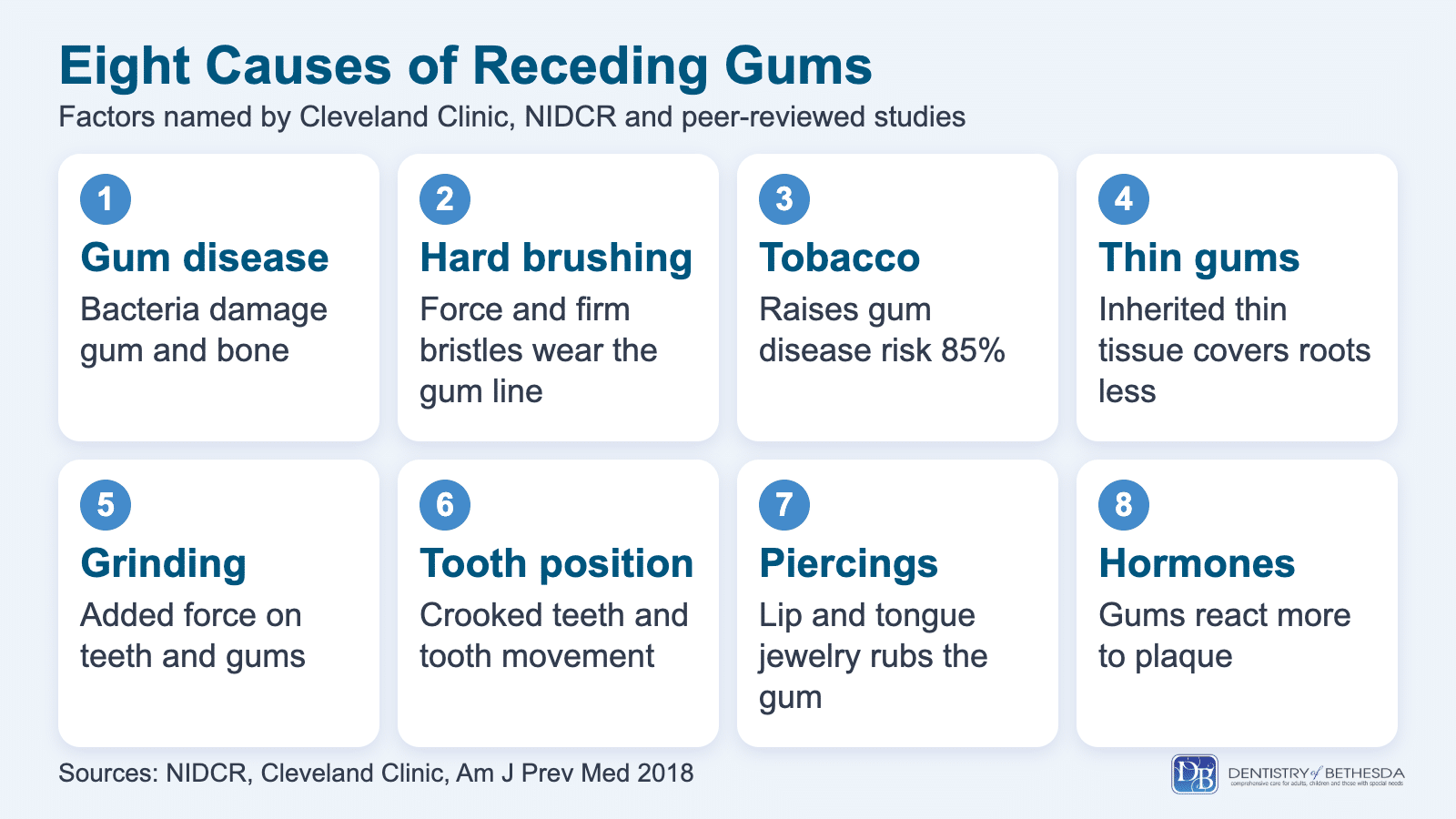
The graphic above shows all eight causes of receding gums in one view.
Does Gum Disease Cause Receding Gums?
Yes, gum disease causes receding gums when bacteria destroy gum tissue and the bone that holds teeth in place. NIDCR states that plaque and tartar contain bacteria that inflame the gums and damage supporting tissues. Only a professional cleaning removes tartar.
A JADA analysis of CDC survey data found periodontitis in about 42% of dentate US adults 30 and older. Severe periodontitis affected 7.8%. The study found severe disease most prevalent in adults 65 and older and in smokers.
Gum disease starts with bleeding gums that go unnoticed because early disease is painless. The next cause involves daily habits.
Does Brushing Too Hard Cause Receding Gums?
Yes, brushing too hard is linked to receding gums, although the evidence is mixed. A 2007 systematic review found 8 of 17 observational studies reported a positive link between brushing and recession. The review appeared in the Journal of Clinical Periodontology. Two studies found no relationship.
The same review listed brushing force, bristle hardness, technique, and toothbrush age as other possible factors. The ADA advises a soft-bristled brush because firm or medium bristles may damage gums and enamel. The ADA also says to brush only hard enough to clean the film off teeth.
Brushing is one habit among several. Tobacco is another habit with stronger evidence.
Does Smoking Cause Receding Gums?
Yes, smoking and tobacco use raise the risk of gum disease, which drives recession. NIDCR calls tobacco use the most significant risk factor for gum disease. Tobacco also delays healing and makes gum treatment less successful, according to NIDCR.
A 2018 meta-regression from Aarhus University pooled 14 studies. The analysis found smoking raises the risk of periodontitis by 85%, a risk ratio of 1.85.
Tobacco is a choice, but tissue type is inherited. Genetics come next.
Can Genetics Cause Receding Gums?
Yes, genetics can cause receding gums because some people inherit thin gum tissue. Cleveland Clinic states that many people have a genetic predisposition to thin gum tissue. Cleveland Clinic adds that poor hygiene contributes in some cases, but it is not always the reason.
A 2023 review in the European Journal of Orthodontics from KU Leuven supports the tissue-type link. Nine articles found that a thin gingival biotype raised the risk of recession after orthodontic treatment.
Inherited tissue sets the baseline, and daily force from the jaw can add stress. Grinding is the next factor.
Can Teeth Grinding Cause Receding Gums?
Yes, teeth grinding is associated with receding gums, based on limited evidence. A 2023 case-control study in the Journal of Oral Rehabilitation compared 149 dental students aged 18 to 25. Self-reported bruxism was significantly associated with recession on the cheek-side of teeth.
The authors called for further studies to confirm the effect of bite interference on recession. Patients who clench or grind can have teeth grinding evaluated as part of a full exam.
Force on the teeth can also come from bite alignment, which leads to hormones next.
Do Hormones Cause Receding Gums?
Yes, hormone changes make gums more sensitive to plaque, and gum inflammation can lead to recession over time. MedlinePlus, from the National Institutes of Health, lists pregnancy as a time when hormonal changes increase the sensitivity of the gums. MedlinePlus also links gingivitis to puberty.
NIDCR lists hormonal changes in girls and women among factors associated with gum disease. The sources link hormones to gum sensitivity and gum disease.
Hormones affect tissue from the inside. Piercings affect it from the outside.
Do Lip and Tongue Piercings Cause Receding Gums?
Yes, lip and tongue piercings are linked to receding gums. A 2022 meta-analysis from Newcastle University covered 54 studies. The analysis found that an oral piercing carried a seven-fold higher risk of gingival recession, with low certainty of evidence.
Among pierced participants, 33% had gum recession. Cleveland Clinic also lists lip and tongue piercings among recession risk factors.
Piercings are optional, but tooth position is built into the bite.
Can Braces or Crooked Teeth Cause Receding Gums?
Yes, crooked teeth and some orthodontic movement can contribute to receding gums. Cleveland Clinic lists abnormal tooth positioning and orthodontic treatment among recession risk factors.
The 2023 KU Leuven review found more recession in 10 of 16 articles when incisors were tilted forward during treatment. The review found no link to oral hygiene, sex, or treatment length. Patients with crooked teeth can ask a dentist how tooth position affects the gum line.
Causes stack up across a lifetime, which brings age into the picture.
What Causes Receding Gums in Adults?
What causes receding gums in adults is the same list of causes acting over more years. Recession rises with age, according to a JADA review by the State University of New York at Buffalo. The review counted recession at one or more sites in 50% of adults 18 to 64. The count was 88% for adults 65 and older.
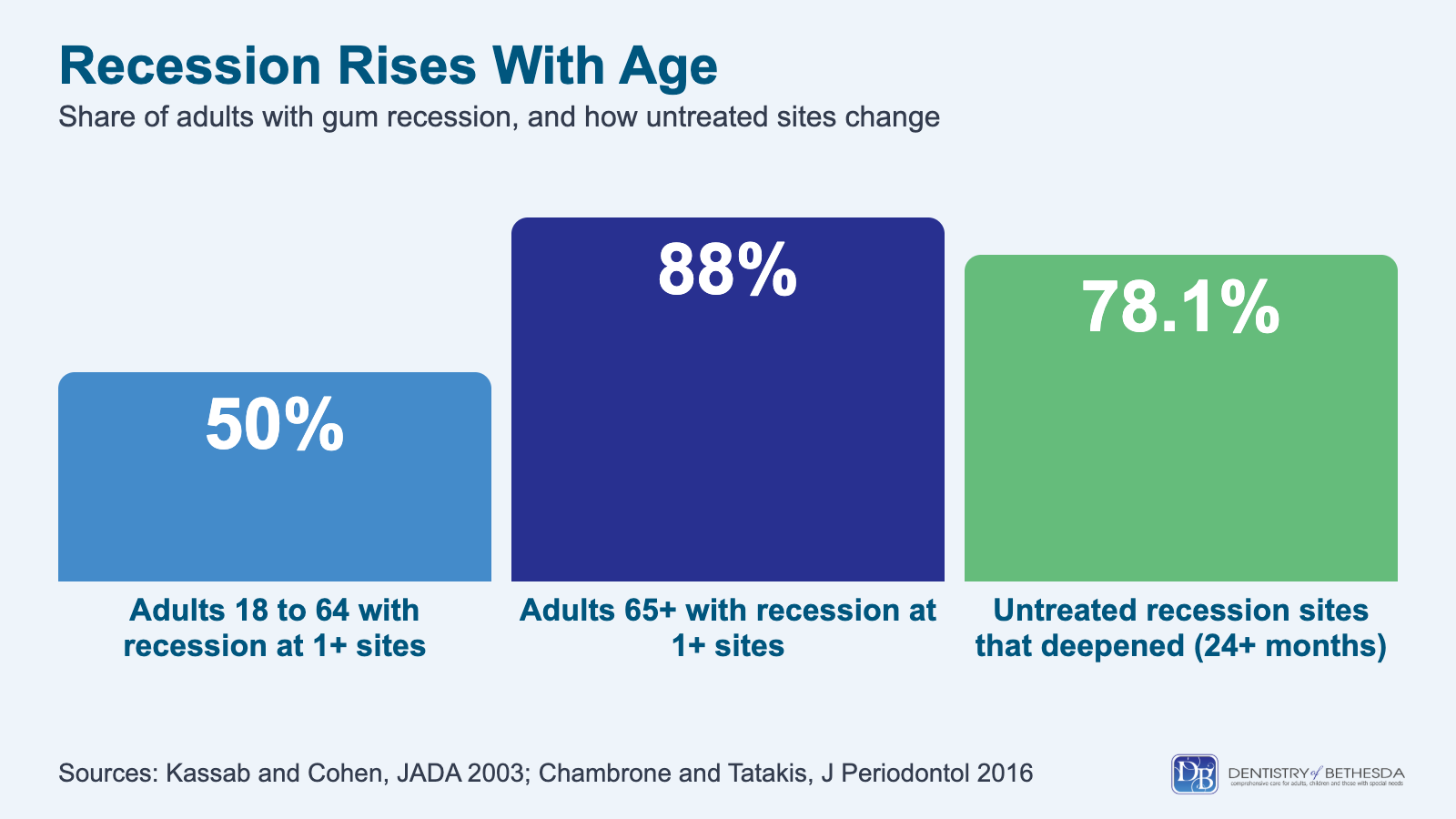
The chart above compares the two age groups and shows how often untreated recession deepened.
The same review found recession of 1 millimeter or more at one or more sites in over half the population. The review linked recession to trauma, malpositioned teeth, inflammation, and tobacco use. Adults can check whether one of those applies to them.
Why Do I Have Receding Gums?
You may have receding gums because of one or more causes above, and hygiene is not always the reason. The JADA review found recession in patients with both good and poor oral hygiene. A thin gum layer, bite force, or a piercing can each be enough.
A 2016 meta-analysis in the Journal of Periodontology adds a warning. The analysis found that untreated recession in people with good oral hygiene has a high probability of progressing during long-term follow-up. A dental exam shows which cause applies.
That exam starts with what the gums look like.
What Do Receding Gums Look Like?
Receding gums look like gum tissue pulling away from the teeth, which makes teeth appear longer and exposes the root. Cleveland Clinic calls tooth root exposure the most apparent sign of recession.
The table compares healthy gums with receding gums using features that Cleveland Clinic and Oral-B describe.
The graphic below shows the same comparison in a side-by-side panel.
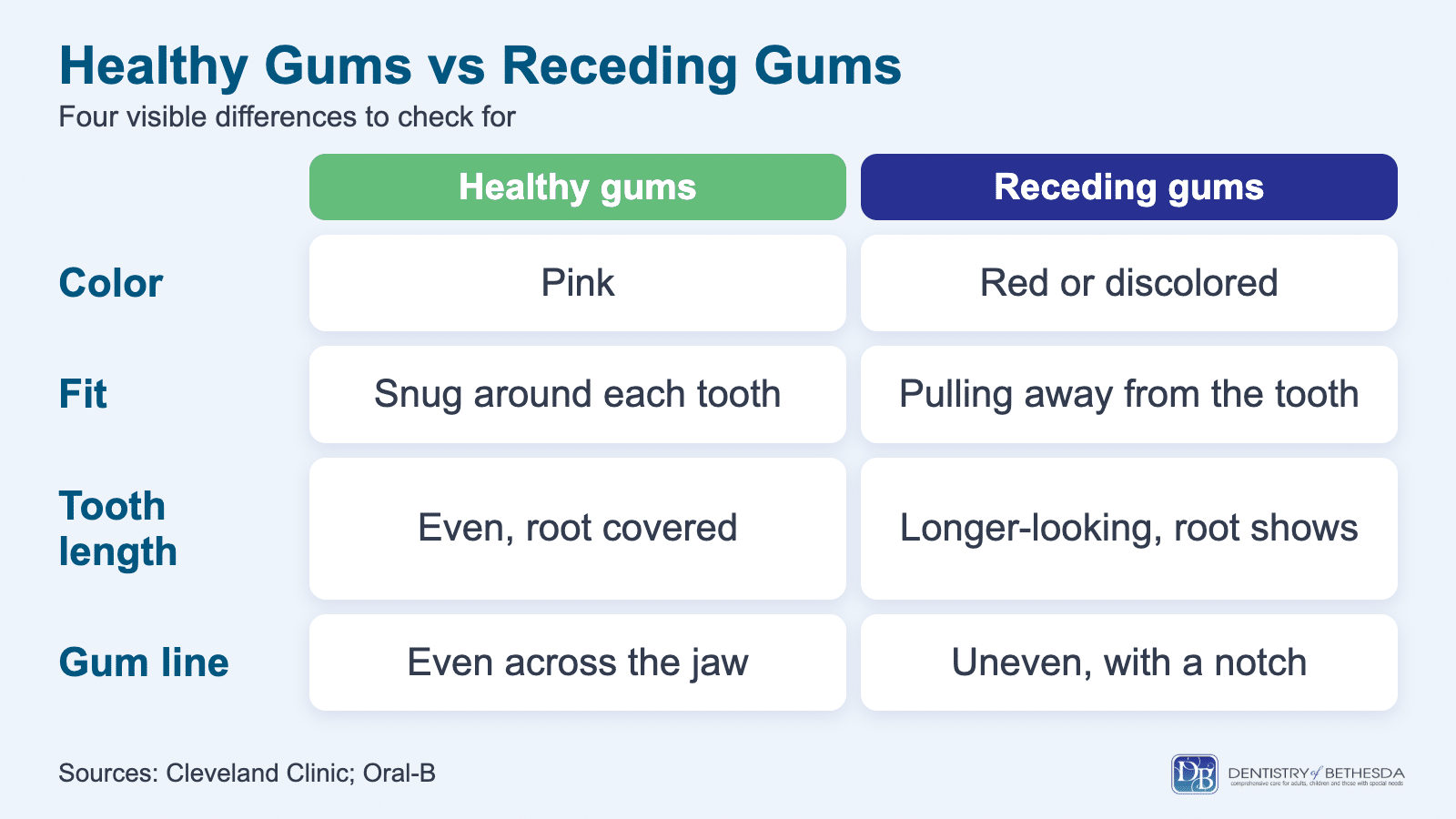
A notch at the gum line is easy to feel with a fingernail or tongue. A dentist measures it with a periodontal probe to confirm.
What Are the Early Signs of Receding Gums?
The early signs of receding gums are a longer-looking tooth, a small notch, and new sensitivity to hot or cold. Oral-B describes these as the first changes you can see and feel. Changes can build over years or appear within weeks.
The list below shows the early signs of receding gums to watch for.
- One tooth looks longer than the teeth beside it.
- A small notch or dip sits at the gum line.
- Teeth react to hot or cold drinks.
- Gums look red or puffy near the edge.
- Gum lines look uneven from one side to the other.
Early signs may be subtle, so symptoms deserve their own look.
What Are the Symptoms of Receding Gums?
The symptoms of receding gums include pain near the gum line and sensitivity to heat, cold, and sweets. Cleveland Clinic also lists sensitivity while brushing, flossing, and during cleanings. Exposed roots feel sensitive because they are covered by cementum, which is less strong than enamel.
Left untreated, recession can lead to bone loss, loose teeth, and tooth loss, according to Cleveland Clinic. Cigna adds bad breath and bleeding after flossing to its list of signs. The signs of receding gums overlap with gum disease, so a dental exam sorts out the cause.
Symptoms grow stronger as recession advances, which leads to the stages.
What Are the Stages of Receding Gums?
The stages of receding gums are early, moderate, and severe, although no formal staging system exists for recession itself. Oral-B describes progression by what you see and feel. The table below summarizes each level.
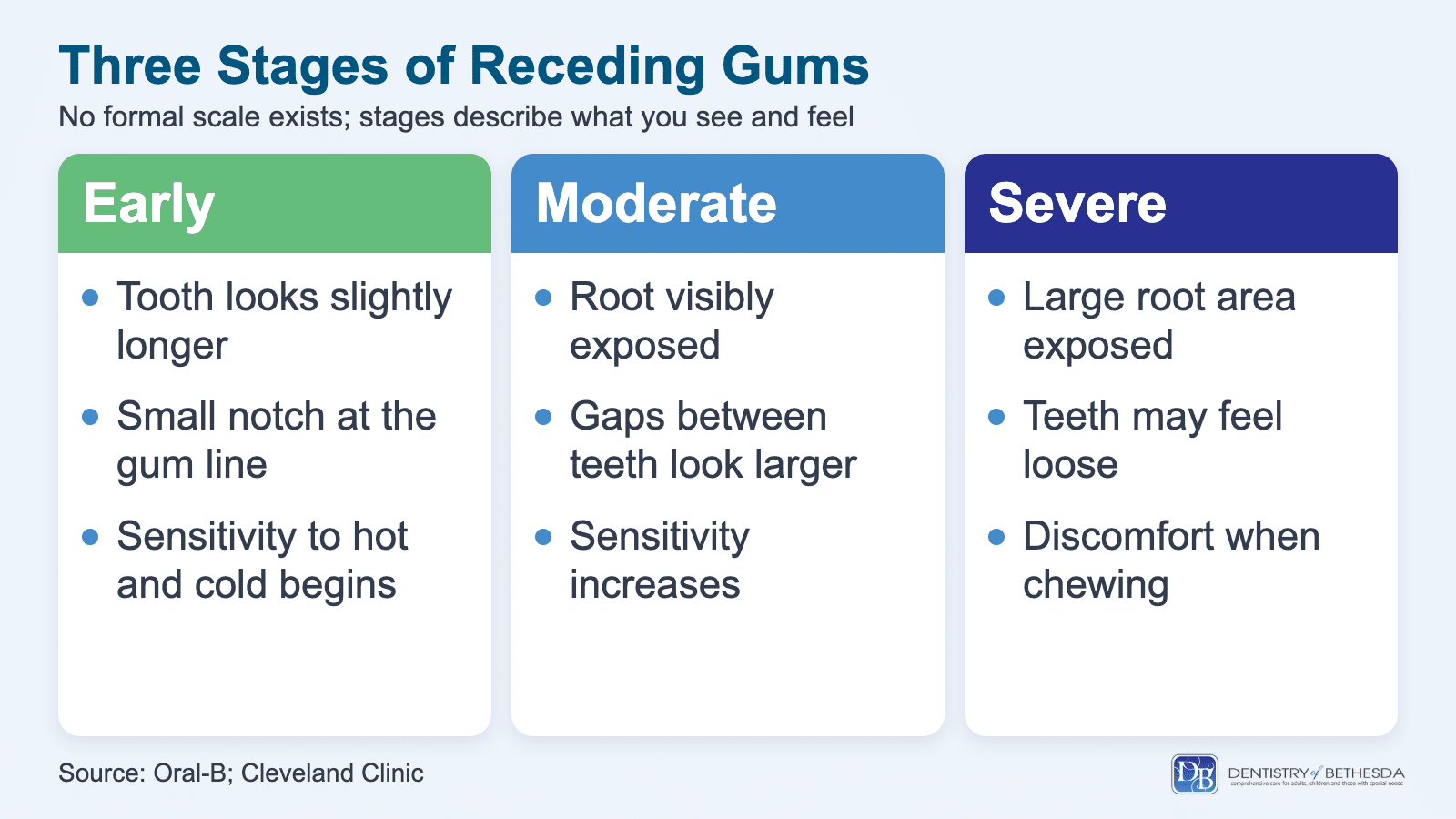
The timeline above lays out the three stages in order.
Recession can look like inflamed gums, so the two are easy to confuse. Gingivitis has its own look.
What Do Gingivitis Gums Look Like?
Gingivitis gums look red or reddish-purple, swollen, shiny, and tender to the touch, and they bleed when you brush or floss. MedlinePlus lists bleeding with brushing or flossing as a key sign. The gums are usually painless or only mildly tender.
Gingivitis is inflammation from plaque, and it is an early form of periodontal disease. Gingivitis is different from recession because the gum tissue is not yet lost. Dr. Hornstein’s team explains the link between gum inflammation and later tissue loss.
What Do the Early Stages of Gingivitis Gums Look Like?
The early stages of gingivitis gums look slightly red, puffy, and shiny, and they may bleed when you floss. Early gum disease can often be reversed by daily brushing and flossing, according to NIDCR. Once gums progress to periodontitis, professional treatment is needed.
MedlinePlus says gingivitis develops during puberty or early adulthood because of hormonal changes. Professional cleanings twice a year are the standard care, and severe cases may need three to four visits a year.
Gingivitis can be reversed, but recession cannot be reversed by brushing alone. That difference leads to a set of related questions.
What Else Should You Know About Receding Gums?
Can Receding Gums Grow Back?
No, receding gums cannot grow back on their own. Cleveland Clinic states that gum tissue that has receded does not regrow, but steps can stop recession from worsening. Repair options such as grafting appear in Dr. Hornstein’s receding gums treatment guide.
Cleveland Clinic says a dentist can apply fluoride varnish or other desensitizing agents to reduce discomfort. A desensitizing toothpaste can help at home.
How Fast Do Receding Gums Get Worse?
Receding gums get worse over months to years, and no source gives a fixed rate. A 2016 meta-analysis co-authored at Ohio State University found 78.1% of 1,647 untreated recession defects deepened. Follow-up lasted at least 24 months. New defects appeared as well.
The same analysis found a 79.3% increase in the number of recession defects among followed patients. Gum infection speeds that pattern, as described in Dr. Hornstein’s overview of gum disease progression.
How Do Dentists Check for Receding Gums?
Dentists check for receding gums by measuring the gum line on each tooth with a periodontal probe. Cleveland Clinic states that healthy pockets measure 1 to 3 millimeters. Pockets of 5 millimeters or more point to periodontal disease. NIDCR also says an X-ray can show bone loss.
Regular dental cleanings give a dentist the chance to track these numbers over time. Medical history, tobacco use, and diabetes are also reviewed because they can contribute to gum disease.
How Can You Prevent Receding Gums?
You can prevent receding gums by lowering plaque, brushing force, and tobacco exposure. Six habits from the ADA and NIDCR make up the plan, and a soft-bristled brush used gently is the first one.
- Brush twice a day with a soft-bristled brush and fluoride toothpaste, as the ADA advises.
- Brush only hard enough to clean the film off your teeth.
- Clean between teeth once a day to remove plaque under the gum line.
- Replace the toothbrush every three to four months, or sooner if bristles fray.
- Quit tobacco, which NIDCR names as a gum disease risk factor.
- Book professional cleanings, because only a dentist or hygienist can remove tartar.
The steps above also follow Dr. Hornstein’s advice to prevent gum disease before recession starts. Gum disease prevention and recession prevention overlap closely.
How Does Dentistry of Bethesda Help With Receding Gums?
Dentistry of Bethesda helps with receding gums by examining the gum line, measuring recession, and reviewing brushing habits. Dr. Hornstein, a Master of the Academy of General Dentistry, leads each exam. We explain the cause of the recession in plain language.
When gum disease is present, our periodontal therapy removes bacterial buildup below the gum line. We also discuss tobacco, grinding, and tooth position when they apply. Each care plan starts from the exam findings and the patient’s own goals.
Patients with a longer-looking tooth, a notch, or new sensitivity can call us at (301) 530-2700. Visit Dr. Hornstein’s practice online to plan an exam.