

Yes, some dental insurance plans cover implants, but each plan sets its own rules, limits, and waiting periods. According to the American Dental Association, 48.2% of in-network annual maximums fall between $1,500 and $2,500. A plan may pay for an extraction, a bone graft, or the crown even when it excludes the implant post. Reading the plan wording first prevents surprises.
Key Takeaways
- Coverage for implants is set plan by plan, so the summary of benefits gives the real answer.
- The ADA reports that 32.8% of in-network annual maximums sit between $1,000 and $1,500.
- Original Medicare does not cover dentures or implants in most cases, according to Medicare.gov.
- Medical insurance may apply when tooth loss links to an injury or a covered medical treatment.
- A pre-treatment estimate, a second plan, an HSA, or a health FSA can reduce what you pay.
Does Dental Insurance Cover Implants?
Dental insurance covers implants only when the plan lists implants as a covered service. Each plan decides its own percentage, limits, and exclusions. HealthCare.gov states that adult dental coverage is not an essential health benefit, so health plans are not required to include it.
The question “does dental insurance cover implants” therefore has a plan-specific answer. Searches such as “does insurance cover dental implants” lead to the same plan documents. A plan may list the extraction, bone graft, implant post, and crown on separate benefit lines. Reviewing each line shows which parts of treatment the plan pays toward. Replacing a tooth with an implant restoration involves several of those lines.
Why Doesn’t Dental Insurance Cover Implants?
Dental insurance may not cover implants because a plan can exclude a service or cap yearly spending. Plan design is the reason, not the dentist’s recommendation. The ADA says annual maximums are plan design elements that restrict yearly payments regardless of clinical need. The question “will dental insurance cover implants” starts with those limits.
The ADA adopted a policy in 2024 stating that it does not support annual or lifetime maximums in any dental benefit program. Plans still set those caps today. Tooth loss also affects chewing and oral health, as missing teeth explains.
How Much Will Insurance Pay for Dental Implants?
How much insurance pays for dental implants is set by the coverage percentage, deductible, and annual maximum. The question “how much does dental insurance cover for implants” has that three-part answer. No single national percentage applies to every plan. The remaining annual maximum caps what the plan pays in a benefit year.
The ADA reports that 32.8% of in-network annual maximums are between $1,000 and $1,500. Another 48.2% fall between $1,500 and $2,500. The final 17.2% sit between $2,500 and no annual maximum at all.
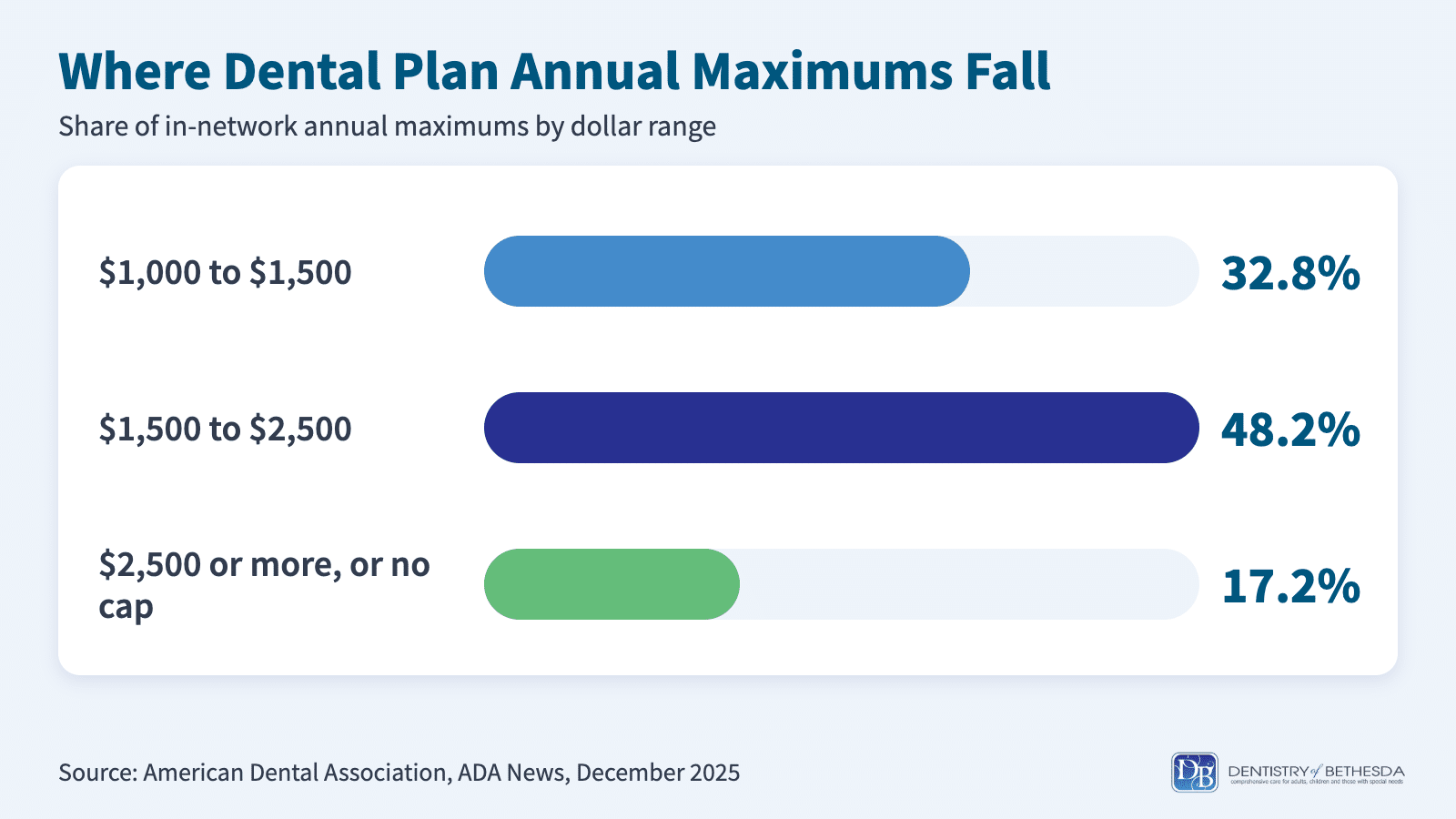
The chart above shows where annual maximums fall. A plan with a $1,000 maximum pays less per year than a plan with a $2,500 maximum. Each plan also states which implant stages count toward that cap.
Which Parts of Implant Treatment Might a Dental Plan Cover?
A dental plan might cover parts of implant treatment such as the exam, X-rays, an extraction, a bone graft, or the crown. Benefit lines differ by plan, so one stage can be covered while another is excluded. The FDA describes an implant system as a body, an abutment, and sometimes an abutment screw.
The table below shows the stages of implant treatment and the question to ask the insurer about each one. The table lists questions, not promises, because every plan words its benefits differently.
Each stage has its own line in the summary of benefits. A dental crown may be listed apart from the implant body, so each line needs a separate check before treatment starts.
What Plan Limits Affect Dental Implant Coverage?
Plan limits that affect dental implant coverage include the annual maximum, deductible, waiting period, and exclusions. Waiting periods and caps change when and how much the plan pays. HealthCare.gov warns that separate dental plans can have waiting periods for adult services.
HealthCare.gov adds that a stand-alone plan will not cover services until the waiting period ends, and premiums are due during that time. The plan document also explains whether it requires approval before treatment. Reading those terms before booking prevents surprises.
The following list covers the plan terms to find in the policy.
- Annual maximum: the most the plan pays in one benefit year.
- Deductible: the amount you pay before the plan begins paying.
- Coinsurance: the share of the cost you pay after the deductible.
- Waiting period: the time before certain services become covered.
- Exclusions: services the plan lists as not covered, which may include implants.
Each term changes what the plan pays. Medical insurance follows different rules, as the next section explains.
Does Medical Insurance Cover Dental Implants?
Medical insurance may cover dental implants only when tooth loss links to an injury or a medical treatment. The medical link decides whether a claim is considered. A plain tooth replacement request falls under the dental plan instead.
Readers who ask “does health insurance cover dental implants” get the same plan-specific answer. Medicare shows how the medical link works in one program. Medicare.gov lists dental exams before a heart valve replacement or organ transplant as covered examples.
Is There a Way to Get Medical Insurance to Cover Dental Implants?
You can ask medical insurance to cover dental implants by documenting an injury, disease, or medical treatment behind the tooth loss. Documentation from your dentist and physician gives the insurer a basis for review. Asking “will medical insurance cover dental implants” starts with the plan’s own definition of medical necessity.
Medicare.gov notes that Medicare may cover a tooth extraction to treat a mouth infection before cancer treatment such as chemotherapy. That example shows that insurers look at the link between the dental procedure and the medical treatment. Each medical plan sets its own list of linked services.
How to Prove Medical Necessity for Dental Implants?
To prove medical necessity for dental implants, gather dentist and physician records that connect the tooth loss to a medical cause. Written records are the evidence an insurer reviews. The insurer then applies its own definition of medical necessity.
Follow these steps to prepare the request.
- Ask the insurer for its definition of medical necessity and its approval process.
- Ask your dentist for a written treatment plan with X-rays and exam notes.
- Ask your physician for a letter that links the medical condition to the tooth loss.
- Submit the request before treatment begins and keep copies of every page.
- Record the claim number and the date of each call with the insurer.
The insurer may approve, reduce, or deny the request. A denial leads to an appeal, which the plan documents describe. Public programs follow separate rules, which the next section covers.
Do Medicare and Medicaid Cover Dental Implants?
Medicare and Medicaid cover dental implants only under narrow rules. Original Medicare does not cover dentures or implants in most cases, according to Medicare.gov. Medicaid.gov states that states have flexibility to decide which dental benefits adults receive.
Medicaid.gov also states that states must provide dental benefits to children covered by Medicaid and the Children’s Health Insurance Program. Adult benefits therefore differ from state to state. The table compares the programs.
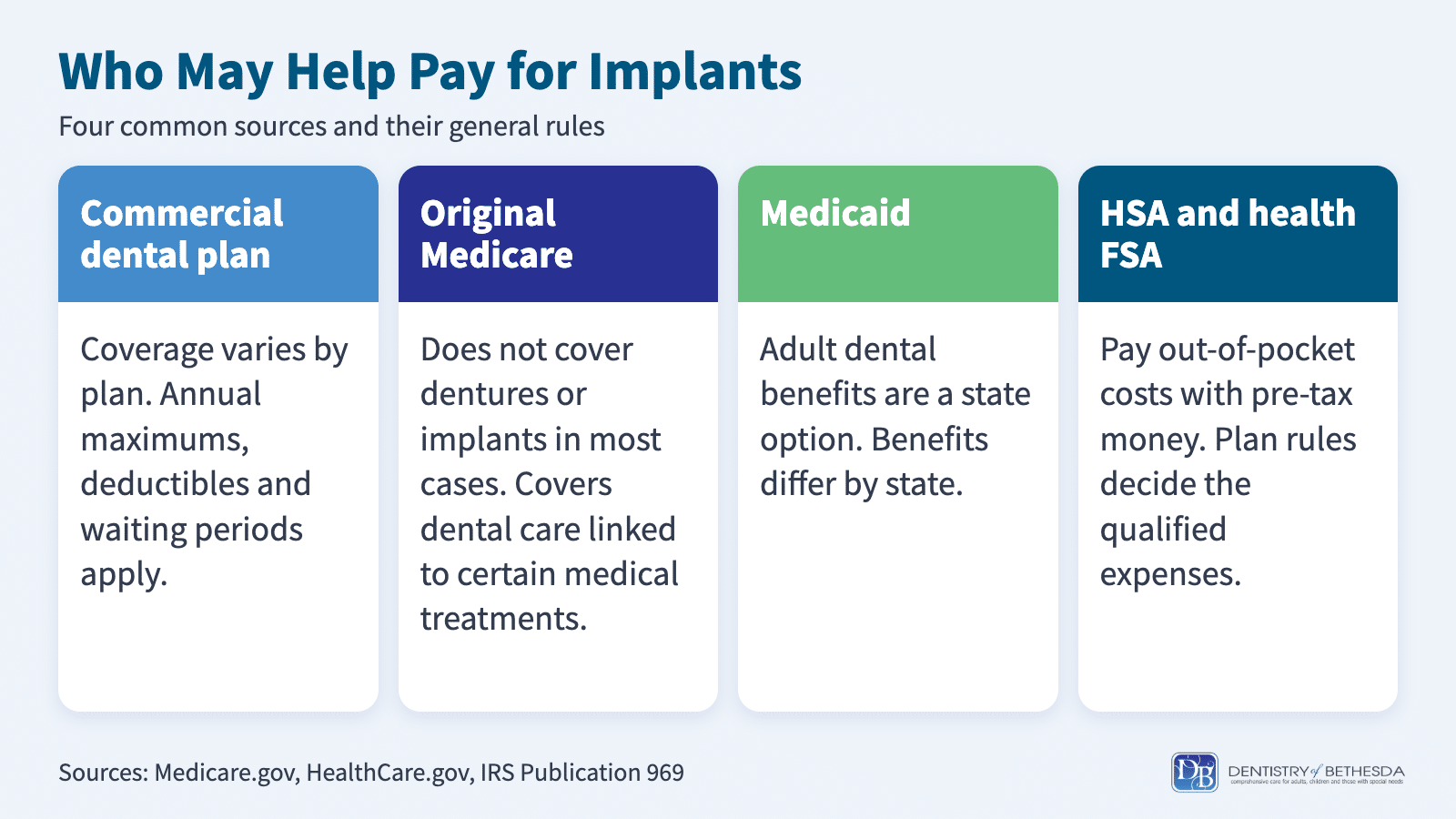
CMS explains that Medicare dental services are excluded by law unless they are integral to another covered service. The state Medicaid office confirms what adult benefits exist locally. The graphic below summarizes four common payment sources.
How to Get Implants Covered by Insurance?
To get implants covered by insurance, review the plan, ask the insurer about each treatment stage, and request a pre-treatment estimate. A written estimate shows what the plan expects to pay before treatment starts. The estimate is not a promise of payment, because eligibility and remaining maximums can change.
The ordered list below turns those actions into five steps. The checklist graphic that follows shows the same sequence.
- Read the summary of benefits and the exclusions list for implant language.
- Call the insurer and ask about the implant body, abutment, crown, extraction, and bone graft separately.
- Ask the dental office to send a pre-treatment estimate to the insurer.
- Review any second dental plan, medical plan, HSA, or health FSA.
- Compare the remaining annual maximum, deductible, and waiting period with the treatment schedule.
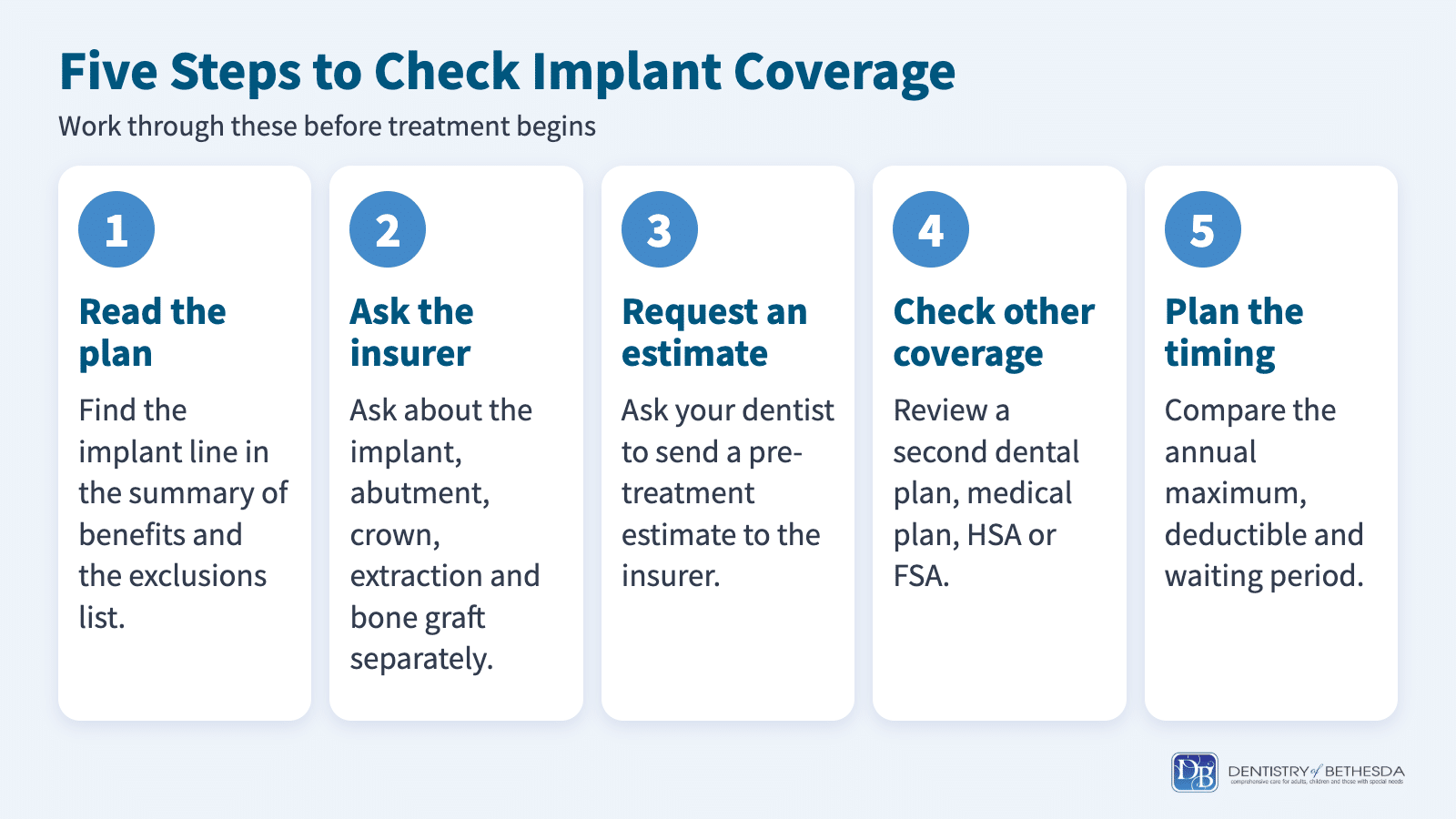
Each step narrows the gap between the plan’s wording and the treatment plan. The remaining cost then becomes the next question.
How Can People Afford Dental Implants?
People can afford dental implants by combining insurance benefits with other tax-advantaged and plan-based options. Pre-tax accounts and plan timing reduce the amount paid from savings. The IRS allows medical and dental expenses above 7.5% of adjusted gross income to be deducted by itemizers.
IRS Topic 502 states that the deduction applies only to expenses not paid or reimbursed by insurance. IRS Publication 969 states that health FSA qualified expenses generally match those that qualify for the medical and dental expenses deduction. The list below summarizes the options.
- Insurance benefits: use the dental plan’s coverage for the stages it lists.
- HSA or health FSA: pay eligible out-of-pocket costs with pre-tax money under the plan’s rules.
- Itemized deduction: deduct unreimbursed costs above 7.5% of adjusted gross income, per the IRS.
- Staged timing: schedule stages across benefit years when the plan allows it.
The plan administrator confirms what an HSA or FSA accepts. A tax professional confirms the deduction. Coverage also changes with age, which the next section covers.
What Else Should You Know About Dental Implant Insurance?
Can Two Dental Plans Both Cover Implants?
Two dental plans can both pay toward implants through coordination of benefits. Only group plans must coordinate, according to the ADA. The plan where you are the employee or main policyholder is primary.
The ADA also states that when a patient has both medical and dental coverage, the medical plan is primary. ADA MouthHealthy states that benefits from all sources should not exceed 100% of total charges. The insurers decide the order of payment.
Does Dental Insurance Cover Dental Implants for Seniors?
Dental insurance covers dental implants for seniors only when the senior holds a plan that lists implants. Fewer seniors hold dental benefits, according to the ADA Health Policy Institute. Among adults 65 and older, 34% have private dental benefits, 11% have public benefits, and 54% have none.
These figures exclude Medicare Advantage plans. The ADA Health Policy Institute reports 64% private, 15% public, and 21% no dental benefits for adults ages 19 to 64. The CDC reports that 13.2% of adults 65 and older have complete tooth loss, based on 2017 to March 2020 data.
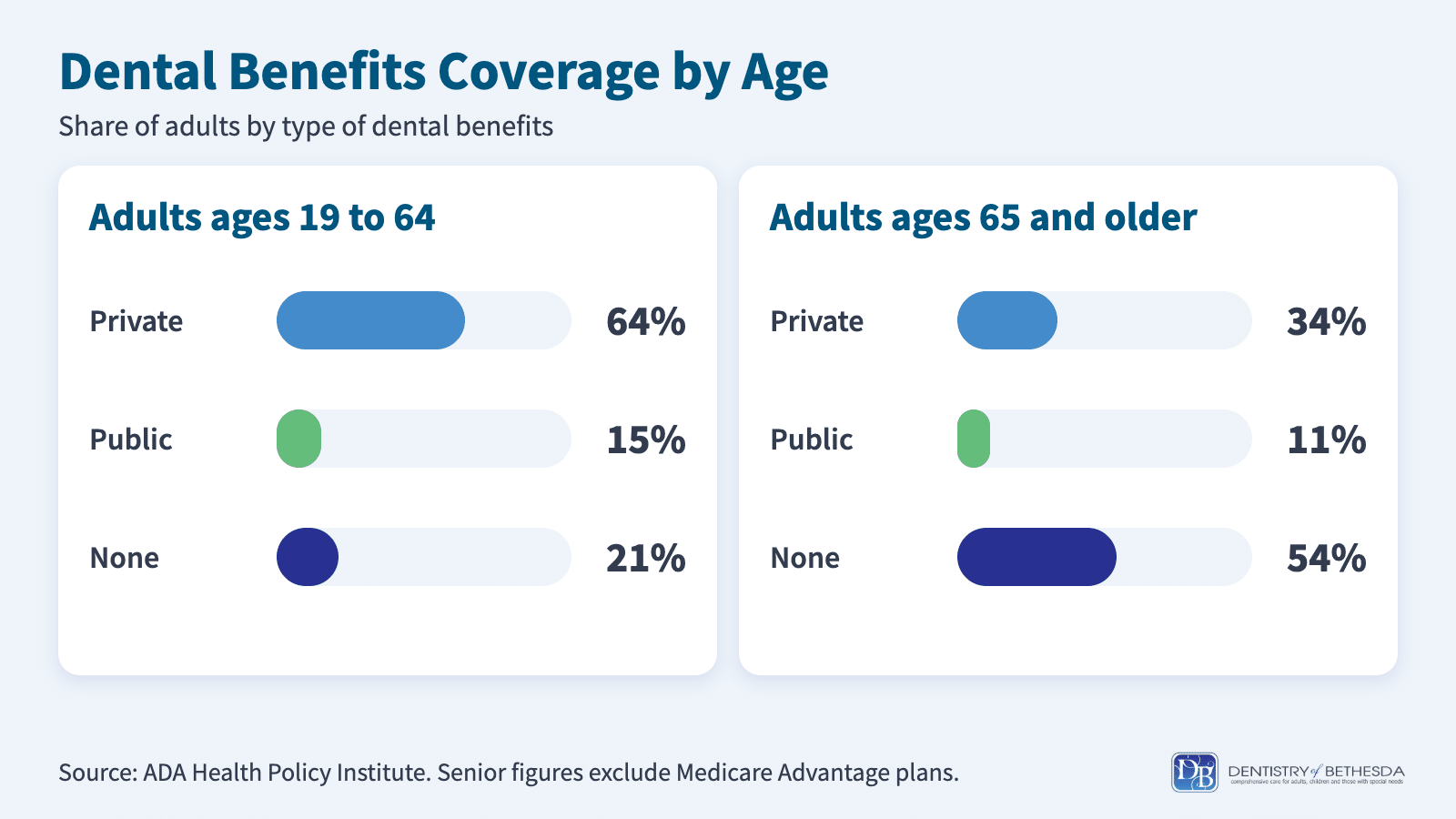
The chart compares both age groups. Seniors who need a tooth replaced can also review senior dental care options with the dental office.
Is There a Cheaper Alternative to Dental Implants?
A cheaper alternative to dental implants may exist in other tooth replacement options, such as a bridge or a denture. Bridges and dentures appear as separate benefit lines in a plan, and each plan words them differently. The insurer states which replacement options the plan lists.
Comparing tooth replacement choices shows how each option fits the plan, the treatment schedule, and the remaining annual maximum for the year. The insurer confirms which replacement options appear in the policy and how each one is paid.
Patients weighing a bridge can read about dental bridge costs with insurance. A bridge follows its own benefit line, separate from implants, and the insurer states what it pays toward that line.
Patients weighing a removable option can read how dentures improve daily function. They can then compare that option with the plan wording and the annual maximum.
Frequently Asked Questions
What Medical Conditions Qualify for Dental Implants?
No single list of medical conditions qualifies a person for dental implants. ADA MouthHealthy states that your health matters more than your age for implant candidacy. Chronic conditions such as diabetes or leukemia can slow healing, and tobacco use can slow healing too.
How to Get Your Dental Insurance to Pay for Implants?
To get your dental insurance to pay for implants, confirm the plan lists implants and request a pre-treatment estimate. The insurer applies its own terms. The estimate is not a promise of payment.
Will Insurance Cover Dental Implants Before the Waiting Period Ends?
Insurance does not cover services before the waiting period ends. HealthCare.gov states that a stand-alone dental plan will not cover services until the waiting period ends. Premiums are still due during the wait.
How Does Dentistry of Bethesda Help With Implant Insurance Questions?
Dentistry of Bethesda helps with implant insurance questions by explaining each treatment stage so you can compare it with your plan. We review the treatment plan with you in plain language. Dr. Hornstein, a Master of the Academy of General Dentistry, leads the care team.
We also help you prepare questions for your insurer before treatment begins. Patients who want to talk through a replacement can review dental implants with us first. We then compare the treatment plan with the policy line by line.
Anyone starting care can find new patients information before booking a visit. The team goes over each treatment step in plain language, so you can match steps to your plan.
The team at Dentistry of Bethesda works with you and your insurer’s estimate to plan each visit. The question “does dental insurance cover implants” gets clearer once the treatment plan is written down.