

How to treat a toothache at home starts with a warm water rinse, gentle flossing, and a cold compress. A labeled pain reliever helps too. The American Dental Association (ADA) lists ibuprofen or naproxen, with or without acetaminophen, for ages 12 and older. Cleveland Clinic advises calling a dentist for pain beyond 2 days. These steps ease pain only and never fix the cause.
Key Takeaways
- Home care for a toothache means rinsing, flossing, a cold compress, and a pain reliever used as labeled.
- The ADA guideline covers ibuprofen or naproxen, alone or with acetaminophen, for ages 12 and older.
- Acetaminophen above 4,000 mg per day is linked to acute liver failure, according to the ADA.
- Aspirin placed on the gum can burn the tissue, and benzocaine products are not for children under 2.
- Pain past two days, face or jaw swelling, or fever calls for a dentist or emergency room.
How Do You Treat a Toothache at Home?
You treat a toothache at home by cleaning the area and calming inflammation. A labeled pain reliever covers the gap until a dentist examines the tooth. The ADA’s MouthHealthy site advises rinsing with warm water and flossing gently first. Clearing trapped food costs nothing and rules out one simple trigger.
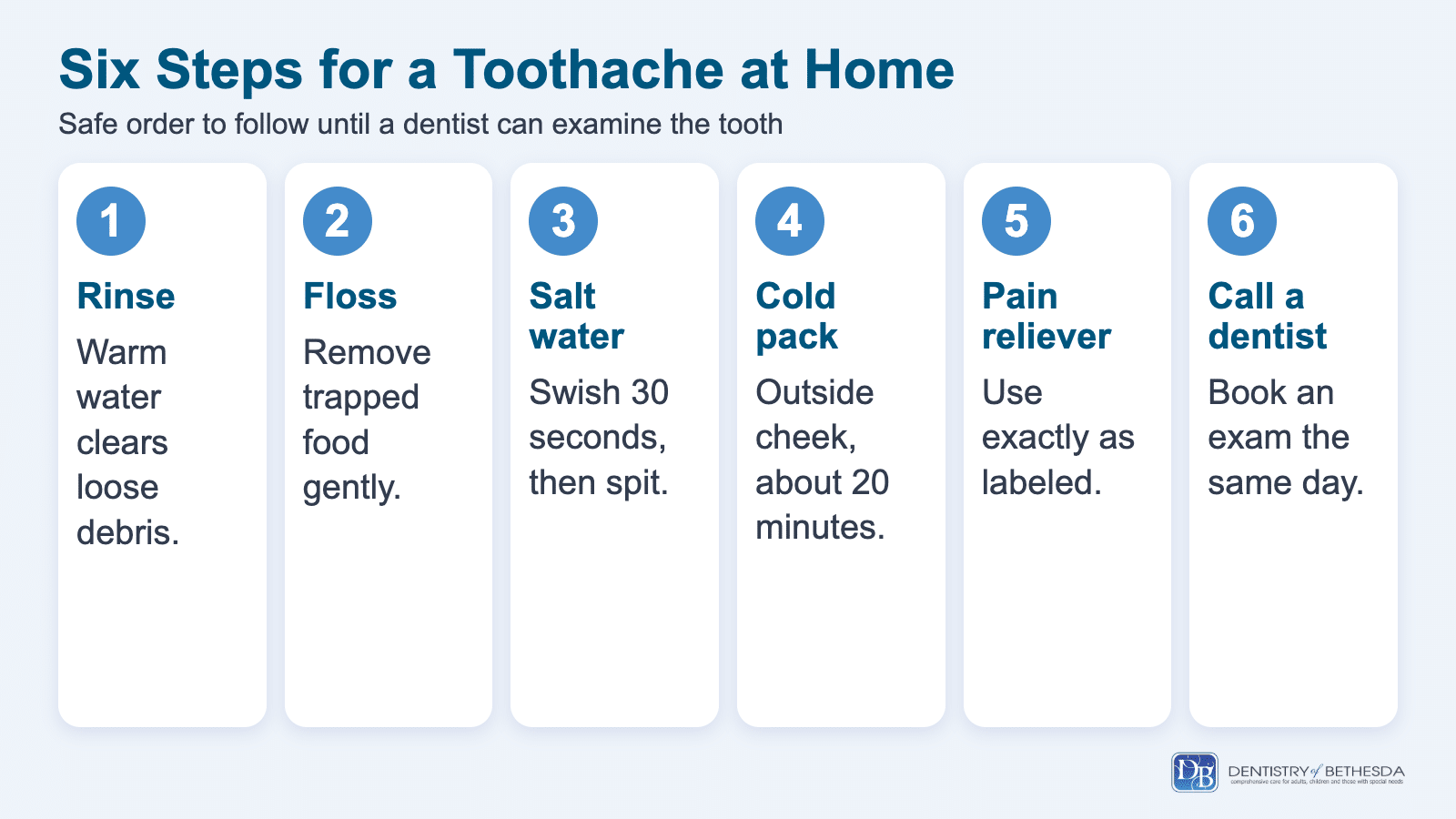
The list below shows what to do for a toothache at home before an exam. The order keeps each step safe. Each step uses a source named later in this post, and dental fillings or other care follows once the cause is known.
- Rinse your mouth with warm water to clear loose debris.
- Floss gently around the sore tooth to remove trapped food.
- Swish warm salt water for 30 seconds, then spit it out.
- Hold a cold compress against the outside of the cheek for about 20 minutes.
- Take an over-the-counter pain reliever exactly as the label directs.
- Call a dentist the same day to book an exam.
Each step supports toothache relief at home without touching the tooth itself. Together they show how to relieve toothache pain at home with low-risk steps. Readers asking how to stop a toothache at home should note that these steps lower pain but do not remove the cause. The next section covers the medicine step in detail, which is the core of toothache pain relief at home.
What Can I Use for a Toothache at Home?
You can use over-the-counter ibuprofen, naproxen, or acetaminophen for a toothache at home. The ADA guideline states that NSAIDs such as ibuprofen and naproxen, alone or with acetaminophen, can manage toothache pain. The guideline applies to people age 12 or older when dental care is not immediately available. NSAID stands for nonsteroidal anti-inflammatory drug.
The ADA explains that NSAIDs reduce inflammation at the painful site, while acetaminophen blocks pain signals in the central nervous system. Taking the two together is highly effective for mild to moderate pain, according to the ADA. The ADA also reports that NSAIDs reduce pain better than opioid medicines.
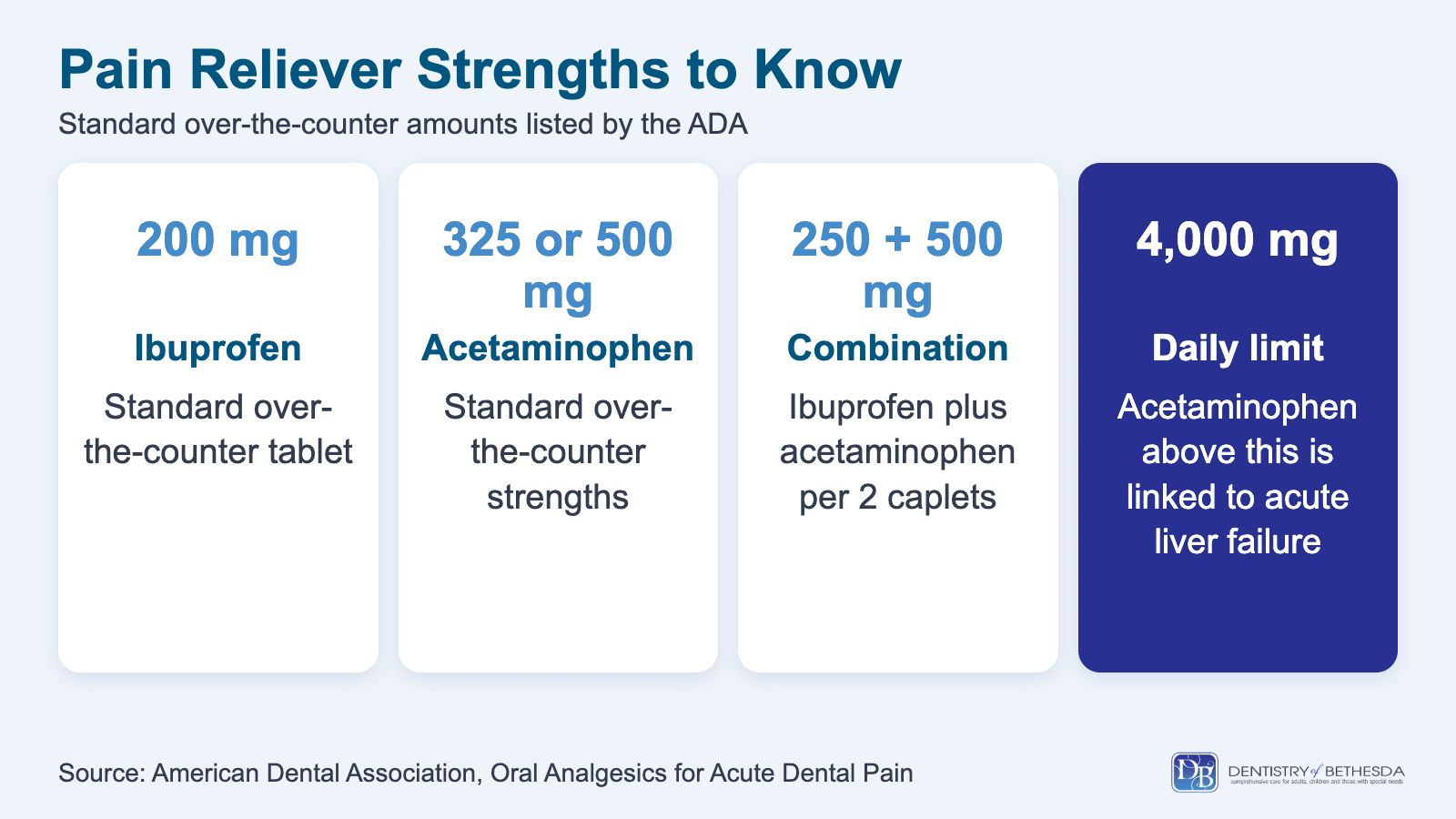
The table below compares the common options by how they work and their standard over-the-counter strength, as listed by the ADA.
The ADA states that the FDA approved the combined product for over-the-counter sale in 2020. A pharmacist can confirm which product suits your health history.
How Much Acetaminophen Is Too Much for a Toothache?
Acetaminophen above 4,000 mg per day is too much, because the ADA links that amount to acute liver failure. Many cold and flu products also contain acetaminophen, so doubling up on ingredients can push the total past the limit without warning.
Reading every label before dosing keeps the daily total clear. The same care applies to rinses, which come next.
Does Salt Water Help a Toothache?
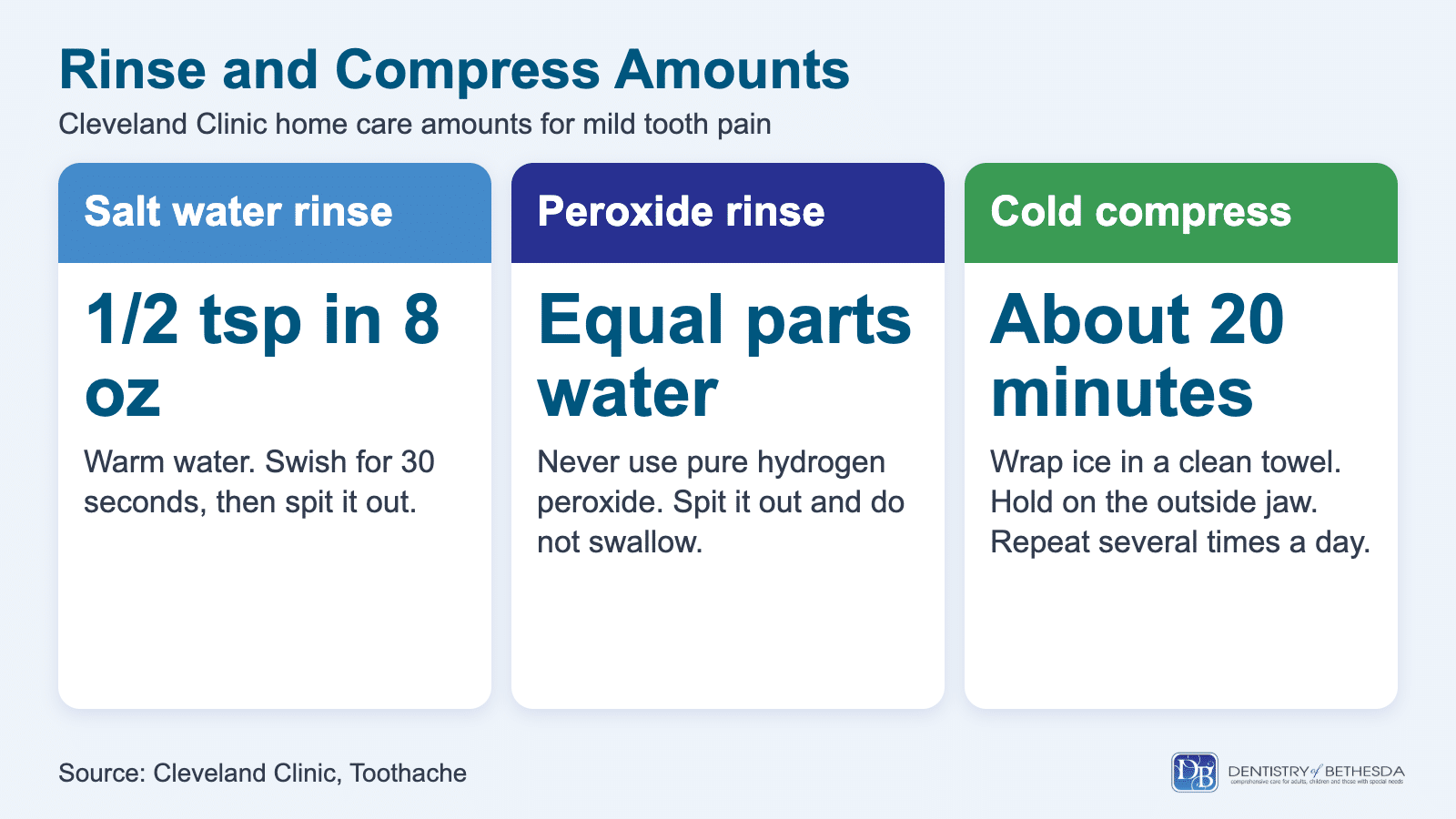
Salt water helps a toothache by cleaning the area and reducing inflammation in the gums around the tooth. Cleveland Clinic gives the recipe as 1/2 teaspoon of salt in 8 ounces of warm water. Swish it for 30 seconds, then spit it out. The simple rinse shows how to soothe a toothache at home without any medicine.
The rinse does not reach pain that starts inside the tooth. Cleveland Clinic states that a cavity or abscess will not go away completely, so the rinse buys comfort only. An exam for cavities shows whether decay is the source, and a small cavity usually needs a filling.
Is Hydrogen Peroxide Safe for a Toothache?
Hydrogen peroxide is safe for a toothache rinse only when diluted with equal parts water. Cleveland Clinic warns that pure hydrogen peroxide should never be used in the mouth. Spit it out in the sink and do not swallow it.
Plain water follows the peroxide rinse. Cleveland Clinic lists the peroxide rinse as a mild option for people with a history of gum disease. Anyone unsure about the strength on the bottle can skip this step and rely on the salt water rinse.
How Does a Cold Compress Help a Toothache?
A cold compress helps a toothache by shrinking blood vessels, which lowers pain and swelling in the area. Cleveland Clinic advises wrapping ice in a clean towel. Hold it against the outside jaw for about 20 minutes. Repeat the step several times a day.
The cold pack stays on the skin and never touches the tooth. Wrapping the ice prevents skin injury. The compress pairs well with an extra pillow at night, which leads to sleep.
How Do You Sleep With a Toothache?
You sleep with a toothache by taking a labeled pain reliever before bed. Add a wrapped cold pack and rest with your head raised. No agency measures the effect of an extra pillow. Still, keeping the head higher than the body costs nothing. Lying flat can feel worse for some people.
Brushing gently and rinsing with warm salt water before bed clears food from the sore area. Skip very hot or cold drinks overnight. A toothache that wakes you repeatedly is a reason to call a dentist the next morning.
What Should You Not Put on a Toothache?
You should not put aspirin directly on a sore tooth or the gum beside it. The ADA’s MouthHealthy site states that aspirin against the gum may burn the tissue. Swallowing a labeled dose is a different matter from placing a tablet on the gum.
The list below shows what to avoid while you wait for an exam.
- Do not place aspirin or any other tablet against the gum.
- Do not use pure hydrogen peroxide as a rinse.
- Do not use benzocaine gels or liquids on children under 2, per the FDA.
- Do not exceed 4,000 mg of acetaminophen in one day.
- Do not poke the tooth with sharp objects.
Is Benzocaine Safe for a Toothache?
Benzocaine is not safe for infants and children younger than 2 years, according to the FDA. The agency warns that these over-the-counter oral products can cause methemoglobinemia, a blood condition. Pale, gray, or blue skin, lips, and nail beds are signs that appear within minutes to two hours.
Anyone with those signs needs medical help right away. Safe use for older children and adults depends on the warning printed on the label.
Why Does Home Treatment Only Work for a Short Time?
Home treatment works only for a short time because rinses, cold packs, and medicine do not remove the cause of the pain. Cleveland Clinic states that antibiotics and pain relievers are temporary, and an infection returns unless the underlying problem is treated. A dentist finds that problem with an exam and an X-ray.
Cleveland Clinic lists several treatments a dentist may recommend. The table below matches each common cause to the care that follows.
Cleveland Clinic describes these as the standard options after an exam. Small damage found early often calls for tooth fillings rather than larger work. The dentist removes the damaged portion first and then fills the space.
A larger fracture may need more protection. Dentists place crowns over the whole tooth, which Cleveland Clinic calls a tooth-shaped cap. The cap strengthens the tooth and reduces the risk of further damage.
Bacteria that reach the pulp call for a root canal, according to Cleveland Clinic. The procedure removes inflamed nerves, blood vessels, and connective tissue from inside the tooth. The dentist then cleans and fills the inner spaces.
When Is a Toothache an Emergency?
A toothache is an emergency when unbearable pain comes with fever and chills. Cleveland Clinic says to call a dentist or go to the nearest emergency room in that case. Infection in the mouth can rarely spread to other areas of the body.
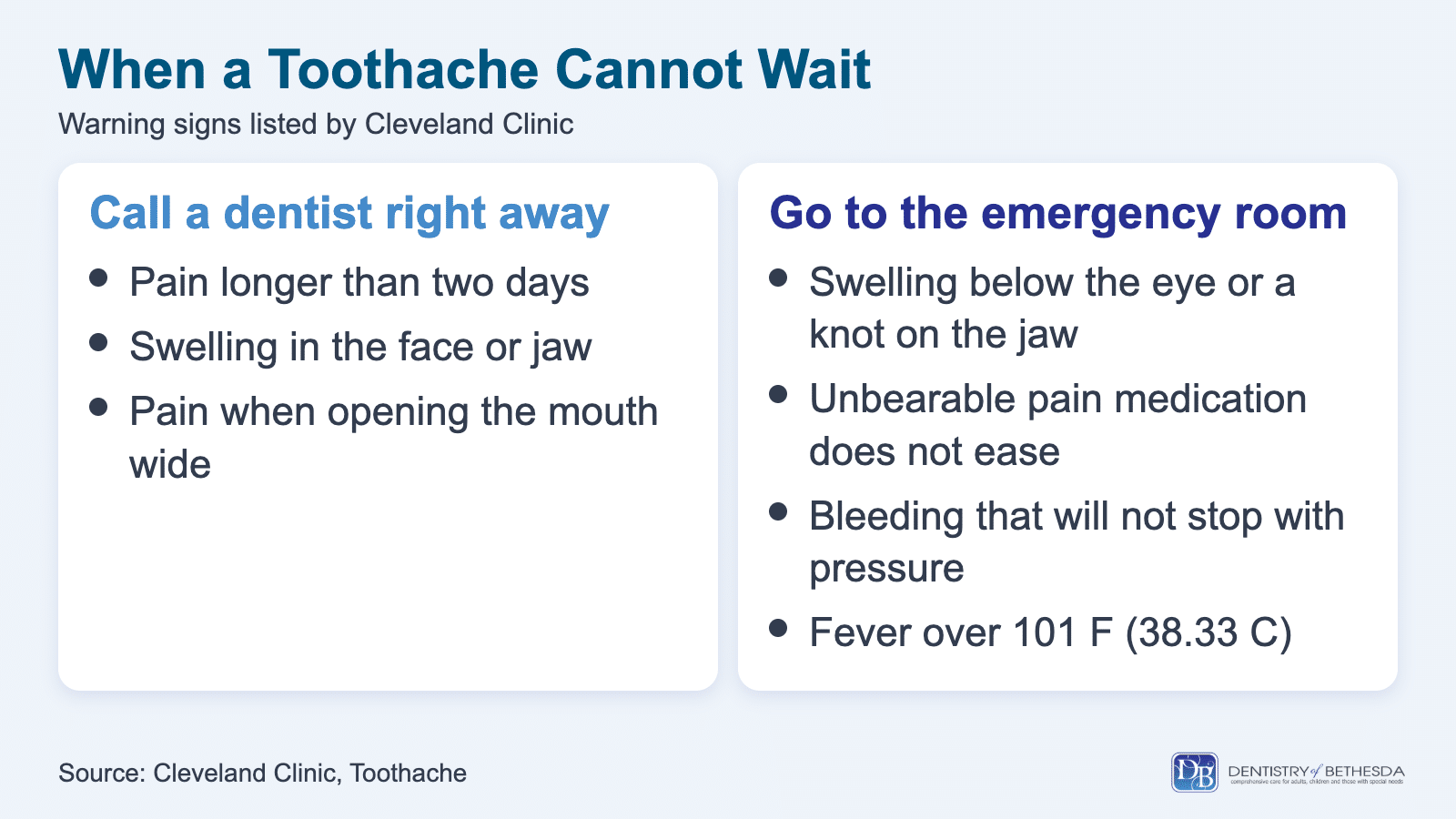
Cleveland Clinic lists signs that call for an emergency room visit. They include swelling below the eye, a knot on the jaw, and bleeding that will not stop with pressure. Unbearable pain that medication does not ease also counts, as does a fever over 101 degrees Fahrenheit (38.33 degrees Celsius).
Cleveland Clinic says to call a dentist right away for pain longer than two days. Face or jaw swelling and pain when opening the mouth wide also call for a call. The ADA reports an estimated 2 million emergency department visits for dental pain each year. Those visits cost three times a dentist visit, averaging $749 without hospitalization.
The graphic below lists the warning signs that move a toothache from home care to a dentist or emergency room.
What Else Should You Know About a Toothache?
Can a Toothache Go Away on Its Own?
A toothache can go away on its own only when temporary gum irritation causes it. Cleveland Clinic states that irritated gums from biting something hard usually settle in a day or two. Pain from the tooth itself usually needs treatment. Learning the early signs of tooth decay helps catch that pain sooner.
Why Is a Toothache Worse at Night?
A toothache feels worse at night because lying down and fewer daytime distractions can make pain easier to notice. No agency lists a single cause, so a dentist should assess pain that wakes you. Raised head position and a labeled pain reliever are the home steps covered above.
Does a Throbbing Tooth Mean Infection?
A throbbing tooth does not prove infection, but Cleveland Clinic names cavities, infection, and cracks among the causes of toothache. Swelling in the gums, fever, and a bad taste can signal an infection. A dentist confirms the cause with an exam and an X-ray.
Does Clove Oil Help a Toothache?
Clove oil is a popular home option, yet no agency in this post endorses it as a toothache treatment. The ADA guideline covers NSAIDs with or without acetaminophen instead. Our clove oil post explains how it is used and its limits.
How Do Other Home Remedies Compare?
Other remedies such as garlic, vanilla extract, and tea bags appear on many websites, but no agency listed here tests them. The ADA and Cleveland Clinic focus on rinses, cold packs, and approved medicine. Our home remedies post reviews the common ones.
What Should You Tell the Dentist About a Toothache?
You should tell the dentist when the pain started, what triggers it, and which medicines you took. Cleveland Clinic states that a dentist performs an examination, asks about your symptoms, and may take a dental X-ray. Clear notes shorten the exam and point to the cause faster.
The list below shows what to write down before the visit.
- The date and time the pain began.
- Whether hot, cold, sweet foods, or biting set it off.
- Which tooth or side of the mouth hurts.
- The pain relievers you took and the dose of each.
- Any swelling, fever, bad taste, or trouble opening your mouth.
Patients who bring this list help the dentist rule out causes. Knowing how to treat a toothache at home covers comfort, not diagnosis. Tooth pain that follows hot or cold drinks may point to tooth sensitivity rather than decay. A call to the office the same day then sets up the exam.
Frequently Asked Questions
Why Does a Toothache Not Go Away With Painkillers?
A toothache does not go away with painkillers when the cause remains inside the tooth, such as decay or infection. Cleveland Clinic lists unbearable pain that medication does not ease as a reason to visit an emergency room.
How Long Can You Wait to See a Dentist for a Toothache?
You can wait up to two days at most. Cleveland Clinic says to call a dentist for a toothache that lasts longer than two days. Swelling or fever means calling the same day.
Can a Cavity Cause a Toothache?
A cavity can cause a toothache, and Cleveland Clinic lists cavities among the main causes. The CDC reports that 20.5% of dentate adults aged 20 to 64 have untreated tooth decay. The data cover 2017 to March 2020.
Is Tooth Sensitivity the Same as a Toothache?
Tooth sensitivity is a short sharp response to hot, cold, or sweet, while a toothache is pain that lingers. Either symptom deserves an exam if it keeps returning.
How Does Dr. Hornstein Help With a Toothache?
Dr. Hornstein helps with a toothache by finding the cause through an exam and recommending care that fits the diagnosis. We see patients for pain, from small cavities to infections that reach the pulp. Early visits keep treatment simpler, so how to treat a toothache at home should end with a call to us.
We also review gum health, since periodontal care addresses gum infections that can cause pain. Checking the gums at the same visit gives a complete picture of the painful area.
Early care limits how far a painful tooth problem can progress. A prompt exam gives the dentist time to plan the simplest repair. Call us or book an appointment online when a toothache starts.
Dr. Hornstein, Master of the Academy of General Dentistry, welcomes children, adults, and patients with special needs at Hornstein’s dental office in Bethesda.